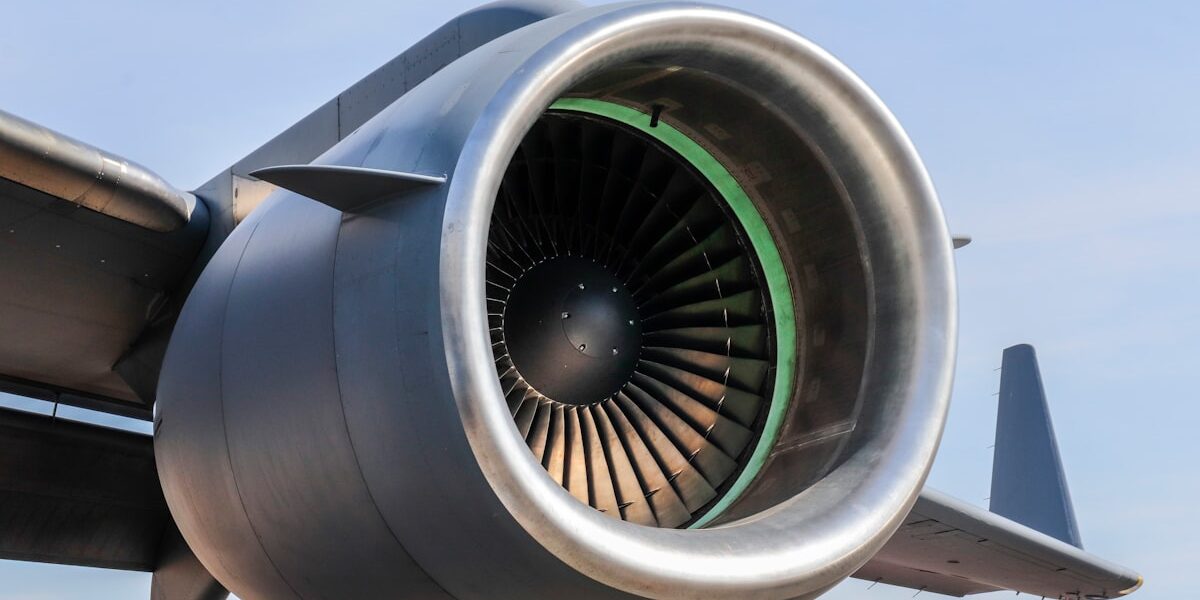
Stand near any major airport today and you’ll notice something different from a decade ago – it’s quieter. Much quieter. The jet engines powering modern aircraft produce up to 75% less noise than their predecessors, a transformation that’s reshaping communities around airports worldwide and enabling flights that would have been impossible under older noise regulations.
The Science of Silence
Aircraft engine noise comes from two primary sources: the high-velocity exhaust gases exiting the engine and the spinning fan blades at the front. Engineers have attacked both problems with increasingly sophisticated solutions.
The most visible advancement is the dramatic increase in engine bypass ratio – the amount of air that flows around the engine core versus through it. Modern high-bypass turbofan engines like the GE9X (powering the Boeing 777X) and Rolls-Royce Trent XWB (on the Airbus A350) push bypass ratios above 10:1. This means over 90% of the thrust comes from relatively slow-moving air pushed by the fan, rather than high-speed exhaust gases. Slower air means less noise.
The Physics of Jet Noise
Understanding why high-bypass engines are quieter requires understanding jet noise physics. Sound intensity from a jet exhaust increases with the eighth power of velocity—double the exhaust speed, and noise increases 256 times. This relationship explains why early turbojets were deafening while modern turbofans are comparatively whisper-quiet.
By moving more air at lower velocity, high-bypass engines generate the same thrust with dramatically reduced noise. A GE90 engine on a 777 moves approximately 1.5 tons of air per second—an enormous volume at relatively modest speed. Concorde’s Olympus engines, by contrast, accelerated far less air to much higher velocities, creating that distinctive supersonic scream.
Chevrons: The Serrated Edge Revolution
Look closely at the engine nacelles on newer Boeing aircraft and you’ll see distinctive serrated edges called chevrons. These saw-tooth patterns at the back of the engine nacelle mix the high-speed exhaust with slower ambient air more gradually, reducing the turbulent noise that occurs when these airstreams collide.
Boeing pioneered chevron technology on the 787 Dreamliner, and the results were dramatic:
- Takeoff noise reduced by approximately 60%
- Approach noise cut by up to 50%
- Significantly smaller noise footprint around airports
The technology has since spread across the industry. Even retrofit chevron kits are now available for older aircraft, allowing airlines to reduce noise on existing fleets without purchasing new planes.
The Engineering Behind Chevrons
Chevron design isn’t simply adding serrations—each installation requires careful optimization. The number of chevrons, their depth, and their orientation affect both noise reduction and engine efficiency. Aggressive chevron designs provide more noise reduction but can reduce thrust. Engineers use computational fluid dynamics and wind tunnel testing to find optimal configurations.
The newest chevron designs incorporate variable geometry, adapting their shape for different flight phases. Aggressive noise reduction during takeoff (when communities are impacted) transitions to efficiency-optimized shapes during cruise.
Advanced Acoustic Liners
Inside modern engine nacelles, specialized acoustic lining materials absorb sound waves before they can escape. These honeycomb-structured panels work like sophisticated soundproofing, targeting specific frequencies that are most annoying to human ears.
NASA’s research into “zero-splice” acoustic liners – continuous panels without gaps – has shown potential for an additional 2-3 decibel reduction. While that might sound modest, decibels are logarithmic: a 3 dB reduction represents cutting perceived loudness nearly in half.
Community Impact
For communities near airports, these noise reductions have been transformative. Properties that were once considered unlivable due to aircraft noise have seen values increase. Schools that required soundproofing can now operate with windows open. Sleep studies show measurable health improvements for residents near airports that have transitioned to quieter fleets.
Consider London Heathrow, one of the world’s busiest airports located in a densely populated area:
- The number of people within the 57 dB noise contour dropped from 258,000 in 2006 to 126,000 in 2023
- Night flight restrictions have been relaxed for the quietest aircraft
- Property values in previously affected areas have increased 15-20%
Health Benefits of Quieter Aviation
Research increasingly links aircraft noise to health problems beyond hearing damage. Studies show elevated cardiovascular disease risk, increased stress hormones, and disrupted sleep patterns in communities exposed to frequent aircraft noise. Children in affected areas show reduced reading comprehension and slower cognitive development.
The transition to quieter aircraft directly addresses these health concerns. As noise footprints shrink, fewer people experience harmful exposure levels. Health authorities in Europe have begun quantifying lives saved and healthcare costs avoided through aviation noise reduction.
Enabling New Operations
Quieter engines don’t just benefit existing routes – they make entirely new operations possible. Airports with strict noise curfews, like Sydney’s ban on flights between 11 PM and 6 AM, are reconsidering these rules for aircraft that meet new noise standards.
Airlines are using their quietest aircraft strategically. Delta positions its newest A350s and A321neos on routes to noise-sensitive airports, gaining competitive advantage through access to off-peak slots that older aircraft can’t use.
The Geared Turbofan Breakthrough
Pratt & Whitney’s Geared Turbofan (GTF) engine, used on the Airbus A220 and A320neo family, represents perhaps the biggest noise reduction advancement of the past decade. By adding a gearbox between the fan and the low-pressure turbine, the engine allows each component to spin at its optimal speed.
The result: the fan can be larger (quieter) while the turbine spins faster (more efficient). GTF-powered aircraft are measurably quieter:
- 75% smaller noise footprint than previous generation engines
- Meets the most stringent Stage 5 noise standards with margin to spare
- Enables operations at noise-restricted airports like London City
What’s Coming Next
Engine manufacturers are already working on the next generation of noise reduction technology. CFM International’s RISE (Revolutionary Innovation for Sustainable Engines) program aims for an open-fan design that could reduce noise by another 20% while cutting fuel consumption by 20% as well.
Airbus and Boeing are also exploring aircraft configuration changes – like engines mounted above the wing or at the tail – that could shield communities from engine noise during takeoff and landing.
The Quiet Future
For passengers, quieter engines mean more comfortable flights with less cabin noise. For airlines, they mean access to more airports and operating hours. But the biggest beneficiaries are the millions of people who live near airports – communities that can finally enjoy peace and quiet even as air traffic continues to grow.
The 75% noise reduction achieved over the past two decades represents one of aviation’s greatest environmental success stories. And with new technologies on the horizon, the industry is far from finished making flying quieter for everyone.




Stay in the loop
Get the latest flighttechtrends updates delivered to your inbox.