
Picture this: a Boeing 787 approaching San Francisco International in dense fog. Visibility is near zero. Yet the pilots see the runway clearly – not through the windshield, but projected onto a transparent screen directly in their line of sight. This is the head-up display, and it’s revolutionizing how pilots land aircraft in conditions that would have grounded flights just decades ago.
Combat Origins
Like many aviation technologies, head-up displays (HUDs) originated in military cockpits. Fighter pilots needed to track targets while simultaneously monitoring flight instruments – looking down at gauges meant losing sight of the enemy. The solution was projecting critical information onto a transparent screen at eye level, allowing pilots to see both the outside world and their instruments simultaneously.
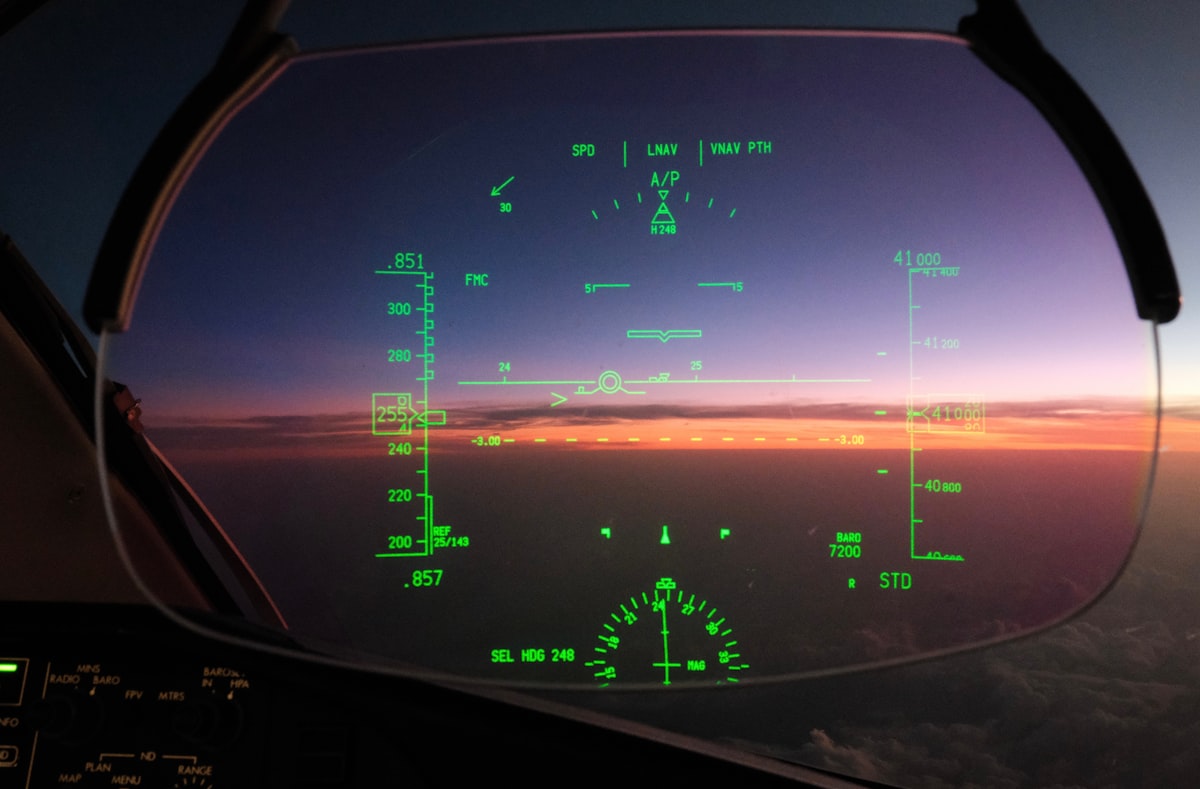
The first HUDs appeared in the 1950s, but they were crude by modern standards – simple gunsight reticles with basic flight data. Today’s HUDs display sophisticated symbology including:
- Flight path vector showing exactly where the aircraft is headed
- Airspeed and altitude tapes
- Heading and navigation guidance
- Approach guidance symbology
- Runway outline and touchdown zone
- Traffic and terrain warnings
Evolution from Military to Commercial Aviation
The transition from military to commercial HUDs required significant adaptation. Fighter pilots needed weapons delivery solutions and target tracking; airline pilots needed approach guidance and situational awareness. The symbology sets diverged accordingly, though the underlying technology remained similar.
Early commercial HUD adopters included Alaska Airlines, which pioneered their use for approaches to challenging Alaskan airports where terrain and weather created unique hazards. The success of these operations convinced other carriers that HUDs weren’t just military technology—they genuinely improved safety.
The Commercial Aviation Breakthrough
Airlines began adopting HUDs in the 1990s, but the real acceleration came when regulators recognized their safety benefits. The FAA and EASA now approve HUD-equipped aircraft for lower landing minimums – meaning they can land in worse weather than aircraft without HUDs.
Standard Category I approaches require 200 feet of ceiling and half-mile visibility. With HUD and enhanced flight vision systems, some operators can now fly approaches with ceilings as low as 100 feet and visibility of 1,000 feet. This capability, called “operational credit,” means fewer delayed and cancelled flights.
The Business Case for HUDs
Airlines invest in HUDs because the operational benefits justify the cost. Each cancelled flight costs an airline tens of thousands of dollars in passenger rebooking, crew repositioning, and schedule disruption. If HUDs enable even a few additional landings per year at fog-prone airports, the systems pay for themselves.
San Francisco International Airport experiences roughly 80 days per year with fog conditions. Airlines with HUD-equipped aircraft report significantly higher completion rates on foggy mornings, translating directly to revenue advantage over competitors.
How Modern HUDs Work
A modern head-up display system consists of several components working in concert:
Projector Unit: A high-brightness display generates the image. Modern HUDs use LED or laser technology to create images visible even in bright sunlight.
Combiner Glass: A specially coated transparent screen positioned in front of the pilot reflects the projected image while allowing the outside world to be visible. The coating is designed to reflect specific wavelengths used by the projector while transmitting all other light.
Computer: A dedicated processing unit calculates the symbology based on flight data, navigation information, and sensor inputs. It must update the display at least 60 times per second to appear stable.
Sensors: Various aircraft sensors provide the data for display – air data computers, inertial reference systems, GPS, and increasingly, enhanced vision cameras.
The Flight Path Vector: A Pilot’s Best Friend
The most important symbol on any HUD is the flight path vector (FPV) – often depicted as a small aircraft symbol or circle with wings. This symbol shows exactly where the aircraft is going, not where it’s pointed.
In still air, an aircraft’s heading and flight path are the same. But in a crosswind, the nose points one direction while the aircraft actually travels another. Traditional instruments show heading; the HUD’s flight path vector shows the true path through the sky. Put the FPV on the runway threshold, and that’s where you’ll land – regardless of crosswind, turbulence, or aircraft attitude.
Understanding Symbology Design
HUD symbology evolved through extensive human factors research. Colors are carefully chosen—typically green or cyan—for optimal visibility against varying backgrounds. Symbol shapes follow conventions that pilots learn during training, enabling instant recognition without conscious thought.
The artificial horizon, airspeed and altitude tapes, and navigation guidance all position themselves to minimize eye movement. Critical warnings appear in the central visual field. Less urgent information occupies peripheral positions. This hierarchy ensures pilots see what matters most when it matters most.
Reducing Pilot Workload
Studies show that HUDs significantly reduce pilot workload, especially in critical phases of flight:
- Pilots make fewer and smaller corrections during approaches
- Decision-making is faster with information displayed at eye level
- Transition from instruments to visual references is seamless
- Situational awareness improves in all conditions
NASA research found that pilots using HUDs maintained better flight path control and detected hazards faster than those using traditional instruments. The “heads-up” advantage is real and measurable.
Integration with Enhanced Vision
The latest HUD systems integrate with enhanced vision systems (EVS) – cameras that see beyond human visual limitations. Infrared cameras can detect runway lights and terrain features in fog. Millimeter-wave radar can penetrate rain and snow. This sensor imagery can be displayed directly on the HUD, giving pilots synthetic vision through the murk.
The Boeing 787 and Airbus A350 offer optional HUDs with EVS integration. Airlines operating in frequently foggy locations – London, San Francisco, Hong Kong – find these systems particularly valuable for maintaining schedule reliability.
Combined Vision Systems
The latest advancement combines enhanced vision (EVS—real camera imagery) with synthetic vision (SVS—computer-generated terrain depiction) into Combined Vision Systems (CVS). This hybrid approach provides backup when one system is limited—synthetic vision fills gaps in camera coverage, while real imagery confirms synthetic accuracy.
Regulators have approved increasingly lower minimums for CVS-equipped aircraft, recognizing that multiple redundant vision sources provide safety margins beyond any single technology.
The Future: Every Aircraft, Every Pilot
HUD technology continues advancing. Newer “holographic” combiner glasses offer wider fields of view. Some manufacturers are developing HUDs that display 3D conformal symbology – virtual representations that overlay and align with the real world outside.
Cost reductions are making HUDs accessible to smaller aircraft. What was once a $100,000+ system is now available for general aviation at a fraction of that price. Eventually, head-up displays may become as standard as glass cockpit screens.
For now, when you’re landing in fog, snow, or heavy rain, there’s a good chance your pilots are seeing the runway clearly – projected in glowing green symbols right in front of their eyes, guiding the aircraft safely to touchdown.


Stay in the loop
Get the latest flighttechtrends updates delivered to your inbox.