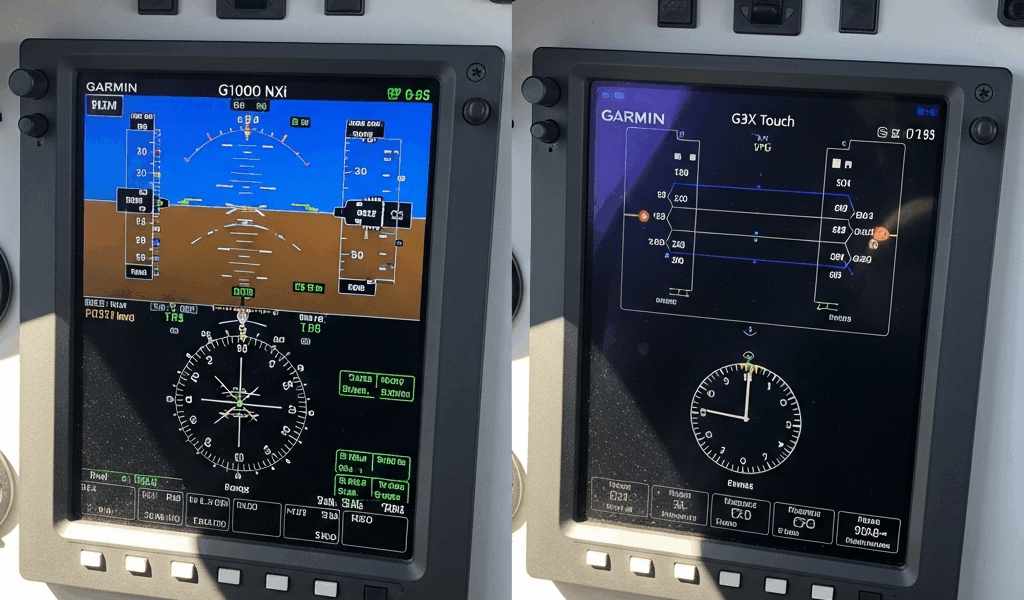
Garmin G1000 NXi vs G3X Touch — Which Wins in 2026
What These Two Systems Actually Are
The G1000 NXi vs G3X Touch debate has gotten complicated with all the half-baked takes flying around pilot forums, Facebook groups, and avionics shop waiting rooms. Most pilots are getting wrong answers — or at least incomplete ones. I’ve flown behind both systems extensively, and the single biggest source of confusion is treating them as head-to-head competitors in the same market. They aren’t. Not exactly.
But what is the G1000 NXi? In essence, it’s a certified integrated flight deck. But it’s much more than that — it lives inside the FAA’s certification framework, ships as OEM equipment in Cessna, Beechcraft, and Piper platforms, and retrofits into certified aircraft through approved STCs. The G3X Touch, meanwhile, was born in the experimental and light sport world. Builder-friendly. Highly configurable. Garmin has been pushing it steadily into Part 23 certified territory in recent years. Same Garmin badge. Very different regulatory DNA. Keep that distinction in your head throughout everything below.
Aircraft Compatibility and Installation Reality
Probably should have opened with this section, honestly, because compatibility is where most pilots hit a wall before they ever get around to comparing features.
The G1000 NXi retrofit market is anchored in certified aircraft — your Cessna 172S, Piper PA-28, Beechcraft Bonanza A36, and similar platforms. Garmin and its approved dealer network hold STCs covering a meaningful slice of the GA fleet. A full G1000 NXi upgrade in a Cessna 172 runs somewhere between $70,000 and $90,000 installed. That depends on your location, the shop’s labor rate, and whether you’re folding in the GFC 700 autopilot. That number stings. It’s also realistic. Budget shops in the Midwest quote lower. Anywhere near a coastal metro, quote higher. Figure 40 to 60 hours of labor minimum on a clean install.
The G3X Touch story is different. In an experimental amateur-built aircraft — an RV-10, a Kitfox, a Sling TSi — the builder installs the suite themselves, legally, no STC required. A competitive experimental panel with dual G3X Touch 10-inch displays, a GFC 500 autopilot, GTN 650Xi navigator, and engine monitoring through the GEA 24 interface box lands around $25,000 to $35,000 in hardware. Labor is either yours or a local A&P on time-and-materials.
Where it gets interesting is the certified side. Garmin has pursued STCs for the G3X Touch in certain certified aircraft — notably the Cessna 172 and a handful of others under the G3X Touch for Certified program. Installed cost in a certified 172 runs roughly $20,000 to $35,000. Substantially less than the NXi path. The tradeoff isn’t imaginary, though. You’re accepting a system with a narrower certified approval footprint and a different support model than a full NXi installation delivers.
- G1000 NXi — certified aircraft, OEM and retrofit, broad STC coverage, higher installed cost
- G3X Touch — dominant in experimental builds, growing certified footprint, significantly lower cost in eligible aircraft
- Part 135 operators — the NXi is the only realistic answer; G3X Touch doesn’t carry the operational approvals most commercial ops require
Cockpit Workflow and Everyday Flying Experience
Frustrated by fat-finger errors on a glass panel during a bumpy IFR descent into KBOS one evening, I started paying close attention to how each system handles the physical act of flying — not just the theoretical feature list sitting in a brochure.
The G1000 NXi uses a hybrid interface. Physical knobs for frequency tuning, course selection, and FMS entry — combined with touchscreen capability that wasn’t present on the original G1000. Those knobs matter more than people give them credit for. In moderate turbulence, dialing in a new altitude or nudging a heading bug with a physical detented knob is faster and more precise than chasing a touch target on a vibrating screen. The NXi’s touch layer is genuinely convenient on the ground and in smooth air. It doesn’t replace tactile feedback when things get rough.
The G3X Touch leans heavily on touch interaction. The interface is more modern-feeling than the NXi — arguably more intuitive for newer pilots. The 10-inch display options give you a clean, uncluttered presentation. Flight plan entry is smooth. Direct-to operations are fast. Ask a pilot to adjust something mid-approach in actual IMC with light chop, though, and the knob-based NXi workflow has a real edge. Not a knock on G3X Touch. An honest workflow difference that matters depending on the environment you fly in most.
Autopilot integration breaks down like this: the NXi typically pairs with the GFC 700 — Garmin’s higher-end certified autopilot with envelope protection and LVL mode. The G3X Touch pairs with the GFC 500 in most installations. Capable and modern, but not identical in certification level or capability envelope. For serious IFR flying in IMC, the GFC 700 and NXi combination is the better tool. Full stop.
Features That Actually Differ Between the Two
Both systems do synthetic vision. Both handle ADS-B In traffic. Both display datalink weather. Listing shared features helps no one. Here’s where the delta is real.
Datalink Weather Display
The G1000 NXi handles SiriusXM weather integration more cleanly in a certified cockpit — largely because of how the MFD layout organizes weather layers alongside flight plan data. The G3X Touch displays weather well. On a single-screen G3X installation, though, screen real estate management can feel crowded compared to a full NXi dual-screen setup. That’s what makes a two-screen configuration endearing to us IFR pilots who actually want weather and moving map simultaneously without squinting.
Engine Monitoring
This is where the G3X Touch wins clearly. I’m apparently obsessive about CHT management on my IO-540, and the GEA 24 engine interface unit works for me in ways the NXi’s engine monitoring never quite did. Granular EGT and CHT data, fuel flow, oil temp, manifold pressure — all displayed cleanly and configurable. Don’t make my mistake of underestimating this capability before you see it in action. Experimental builders love this system for a reason, and that reason is real.
ADS-B In Traffic Handling
Functionally equivalent in day-to-day use. Both display FIS-B traffic correctly. Neither system has a meaningful edge here for the average GA pilot. So, without further ado, let’s move on — because neither box is going to disappoint you on traffic awareness.
Synthetic Vision
The NXi synthetic vision implementation includes terrain alerting tightly integrated with the certified obstacle database. The G3X Touch SVX is excellent and visually comparable — but the certified terrain alerting pipeline in the NXi is more complete for IFR operations. In VFR experimental flying, you genuinely won’t notice the difference.
Which One Should You Choose and Why
Here’s the direct version.
Certified aircraft owner upgrading a panel — you’re looking at either the G1000 NXi or the G3X Touch for Certified, depending on budget and whether your aircraft lands on the G3X STC list. If your 172 qualifies for the G3X certified install and you fly primarily VFR with occasional IFR in decent conditions, the G3X Touch path at $25,000 to $35,000 installed makes genuine financial sense. If you fly IFR seriously and frequently, spend the money on the NXi. The GFC 700 and full NXi integration is the better IFR tool — at least if you want to fly approaches in hard IMC with real confidence.
Experimental aircraft builder — G3X Touch. It’s not close. The flexibility, the community support on VAF and RV forums, the engine monitoring depth, and the cost structure all point the same direction. An RV-10 builder putting in a G3X Touch suite with dual 10-inch displays and a GFC 500 ends up with a genuinely impressive panel for a fraction of an NXi retrofit cost. This new capability footprint took off several years ago and has eventually evolved into the benchmark that experimental builders know and trust today.
Part 135 operator — G1000 NXi, and confirm your specific operational approval requirements with your FSDO before spending a dollar. The G3X Touch doesn’t have the approvals needed for most commercial ops.
Part 61 student renting a 172 — you fly what’s in the airplane. Learn both if you can. Neither will hurt you.
One honest caveat worth naming: Garmin’s support ecosystem for both products is genuinely good by avionics industry standards. Dealer availability varies enormously by region, though. I’ve personally seen avionics shops quote 14-week lead times for G1000 NXi work in 2025. That’s not a product problem — it’s a technician shortage problem. Factor installation wait time into your planning the same way you factor cost. The best avionics decision is the one that actually gets installed before your next flight review.

Stay in the loop
Get the latest flighttechtrends updates delivered to your inbox.