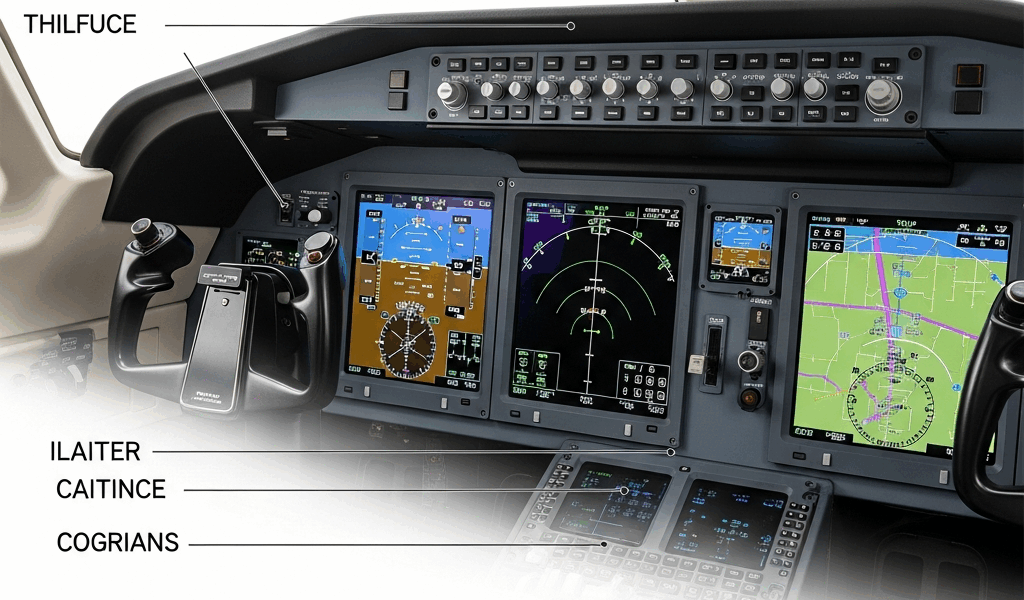
Honda Aircraft Company received FAA certification on February 4, 2026, for Garmin Emergency Autoland on the HondaJet Elite II — making the Honda HA-420 the first twin-turbine business jet in the world to carry the capability. Garmin CEO Cliff Pemble highlighted the milestone during the company’s Q1 2026 earnings call on April 29, confirming the certification alongside an 18% year-over-year jump in aviation segment revenue to $264 million.
For single-pilot operators, the implications are real. If the pilot becomes incapacitated, the Garmin G3000 integrated flight deck takes autonomous control — selects an airport, talks to ATC through a synthesized voice, squawks the emergency code, flies the approach, lands, and shuts down both GE Honda HF120 turbofans. No cabin input needed. Passengers trigger it with one button push. The system can also activate on its own if it detects an unresponsive pilot.
How It Got Here
The path ran through a earlier milestone. The Elite II’s 2024 Autothrottle certification — itself a first for any light jet at the time — gave Emergency Autoland the closed-loop engine power management it needs to execute a complete autonomous approach and landing. Without that foundation, the system can’t work. Honda Aircraft wrapped up EAL certification flight testing in October 2025, clearing the regulatory runway for the February approval.
The Elite II’s G3000 suite already comes loaded: three 14-inch high-resolution displays, dual touchscreen controllers, an Advanced Steering Augmentation System (ASAS), Runway Overrun Awareness and Alerting System (ROAAS), and Autobrake. Emergency Autoland slots into that architecture as a software-enabled capability. No new hardware boxes. Current Elite II aircraft qualify.
“Adding Emergency Autoland to the HondaJet Elite II demonstrates our commitment to delivering new value to our customers. I’m proud that our team is fulfilling on this promise by offering Emergency Autoland and giving our HondaJet Elite II customers greater peace of mind during every flight.” — Hideto Yamasaki, President and CEO, Honda Aircraft Company
The Ninth Type — and Proof the System Works
The Elite II is now the ninth aircraft type certified with Emergency Autoland. It joins the Piper M600/SLS, M700 Fury, Cirrus Vision Jet SF50 G2/G2+, Cirrus SR Series G7+, Daher TBM 940, TBM 960, and Beechcraft King Air 300/350 via G1000 NXi retrofit STC. Garmin reports 1,700 aircraft are flying with Autoland installed.
The system has also proven itself in an actual emergency — not a simulation. On December 20, 2025, a Beechcraft King Air B200 (N479BR) operated by Buffalo River Aviation suffered a rapid, uncommanded depressurization while climbing through 23,000 feet. The pilot lost communication with air traffic control, and Autoland took full control, declared the emergency to Denver Center, and put the aircraft down on Runway 30 at Rocky Mountain Metropolitan Airport — coming to a complete stop and shutting down both engines. Both people aboard walked away unharmed. Garmin confirmed it as the first complete, start-to-finish real-world Autoland activation. The investigation into why the depressurization occurred and whether all systems functioned as designed remains ongoing.
“During the quarter, Daher unveiled their new TBM 980 single-engine turboprop aircraft featuring our G3000 PRIME avionics suite. Also, the HondaJet Elite II was certified by the FAA, becoming the first twin turbine business jet with Garmin Emergency Autoland technology.” — Cliff Pemble, CEO, Garmin Ltd., Q1 2026 Earnings Call, April 29, 2026
What’s Next — GFC 500 and GFC 600 Piston Singles
The Elite II certification will inevitably renew questions about Emergency Autoland reaching GFC 500 and GFC 600-equipped piston aircraft. The short answer is no — at least for now. Emergency Autoland requires a fully integrated flight deck — G3000, G5000, or G1000 NXi — with closed-loop engine management. The GFC 500 is a standalone retrofit autopilot that works with GI 275 or G5 electronic flight instruments, interfaced to a G500 TXi or G3X Touch flight display, but it doesn’t include the Autonomí system architecture that underlies Autoland. The GFC 600 is similarly a standalone retrofit autopilot without that integrated architecture. Garmin has made no public announcement extending Emergency Autoland to either platform.
Expansion is coming elsewhere, though. Certification is slated for next-generation variants of the Cessna Citation CJ3 and CJ4. The Beechcraft Denali single-engine turboprop — which Textron Aviation expects to certify in 2026 — is also on the list. Meanwhile, the TBM 980, unveiled January 15 in Tarbes, France with Garmin’s new G3000 PRIME flight deck, ships with Daher’s HomeSafe emergency autoland as standard equipment at a base price of $5.82 million.
For current HondaJet Elite II owners, Honda Aircraft hasn’t yet published retrofit pricing or a specific service bulletin number for the Emergency Autoland activation. Given how software-centric the integration is, the update will likely come as an avionics configuration upload rather than a hardware changeout — though operators should confirm scheduling and cost directly with Honda Aircraft’s customer support in Greensboro, North Carolina.

Stay in the loop
Get the latest flighttechtrends updates delivered to your inbox.