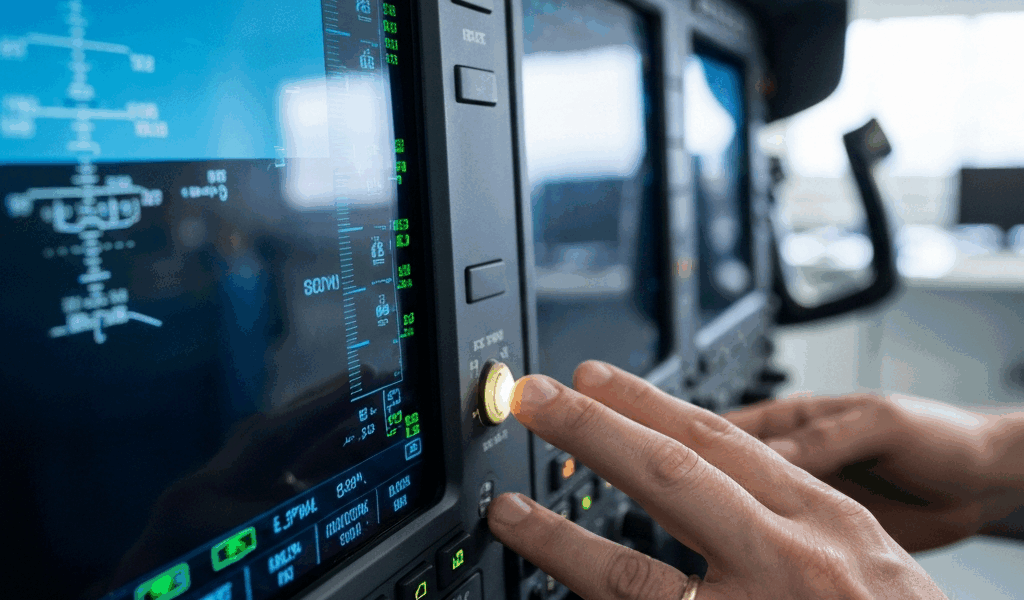
Why Garmin G1000 NXi Softkeys Stop Responding
I’ve been flying glass cockpits for eight years, and honestly, the Garmin G1000 NXi remains one of the most reliable avionics suites in general aviation. But reliable doesn’t mean bulletproof — not by a long shot. The softkey touchscreen, those responsive buttons lining the display bezel, will eventually ghost you. Your finger taps register nothing. The screen lights up fine. Everything else works. The problem sits squarely in the touch sensing layer.
Capacitive touch calibration drift. That’s the most common culprit. The touchscreen uses capacitive sensing, which means it detects the electrical properties of your finger (or a stylus). Over months of thermal cycling — heat from the avionics box, cold from high-altitude flights, pressure changes — the calibration reference points shift. Think of it like a scale that gradually loses accuracy. You’re still pressing with the same force, but the system no longer recognizes that pressure as intentional input. This isn’t a failure. It’s wear.
Corrupted display firmware ranks second. Probably should have opened with this section, honestly. Firmware updates, power-cycle interruptions during startup, or even a lightning strike can corrupt the display’s software. The screen renders perfectly. Navigation works. But the touch controller firmware — that small program managing softkey inputs — gets corrupted just enough that it ignores touch events. Recalibration won’t fix corrupted code. You’ll need a firmware reload.
Hardware failure comes last, but it happens. The actual capacitive touch controller module, a small circuit board inside the display assembly, can fail electrically. Solder joints crack. Components degrade. When this occurs, no amount of calibration fixes it. The hardware simply stopped listening. You’re looking at a display swap or controller module replacement.
Quick Preflight Check Before Any Reset
Don’t jump to calibration yet. Five quick checks eliminate obvious causes and might solve it immediately.
- Inspect the screen surface. Oil residue, dried salt spray, or cleaning product buildup degrades capacitive sensing. I once spent twenty minutes resetting a system only to discover fingerprint residue was blocking the softkey area. Wipe gently with a microfiber cloth slightly dampened — not soaked — with distilled water. Wait five minutes for any moisture to evaporate. Test again.
- Check for condensation or humidity inside the display bezel. Moisture inside the display housing creates a conductive layer between your finger and the actual touch sensor. You won’t see it easily — it hides behind the Perspex cover. If you notice any haziness or slight fogging around the screen edges, the display has internal moisture. This requires professional desiccation. Don’t proceed with calibration if moisture is present.
- Apply consistent button pressure. Soft taps sometimes don’t register on drift-heavy systems. Press each softkey firmly and deliberately. Hold for half a second. If buttons suddenly respond to firmer pressure, calibration drift is your diagnosis. Move to the calibration section.
- Review brightness and contrast settings. Rarely, aggressive display settings interfere with touch sensing. Access System Setup on your MFD, navigate to Display Setup, and reset brightness to factory default — usually 50%. Sometimes this resets the touch layer’s baseline too.
- Perform a soft power-down. Cycle the avionics master switch off for ten seconds, then back on. This resets the display processor without affecting the aircraft systems or requiring a full avionics reboot. If softkeys respond after this, your issue was temporary — possibly a software glitch or thermal state problem.
If any of these five steps restores softkey response, document which one worked. That information helps your avionics technician understand the failure pattern.
How to Recalibrate the Softkey Touchscreen
Recalibration is a four-minute procedure. What it does: re-teaches the system where your softkeys actually are on the physical screen. You’re not replacing software. You’re adjusting the calibration matrix — the mathematical relationship between where you touch and where the system thinks you touched.
Prerequisites: The aircraft must be powered on with avionics running. You’ll need access to the Maintenance Mode, which typically requires knowledge of Garmin’s maintenance access code — ask your shop if you don’t have it. Some systems allow recalibration without maintenance mode entry. Check your G1000 NXi manual’s display section first.
Step 1: Enter System Setup. On your PFD or MFD, press the Menu softkey. Navigate to System Setup. The exact softkey arrangement depends on your display layout, but System Setup always appears in the main menu tree.
Step 2: Access Display Setup. From System Setup, find Display Setup — sometimes labeled “Display” or “Screen Setup”. Scroll through the menu using the outer knob, usually the right side of the flight control unit, until you highlight Display Setup. Press ENTER or the associated softkey to open it.
Step 3: Locate Calibration. Inside Display Setup, you’ll see a Calibration or Touch Calibration option. The exact submenu path varies by avionics software revision — 11.0 versus 12.1, for example — but calibration always nests under display settings. Select it.
Step 4: Run the calibration sequence. The system will display nine or sixteen touch targets — dots or crosshairs — across the screen in sequence. Tap each one precisely at its center. Use a stylus if your shop provided one. It’s more precise than a finger. Don’t rush. The system waits for a solid tap, typically half a second of contact. If you miss a target, it usually repeats or allows a retry.
Step 5: Confirm and save. After all targets are tapped, the system asks you to confirm the new calibration. Select YES or ACCEPT — softkey label varies. The display may black out briefly while it saves the new calibration matrix. Once it returns to normal operation, test each softkey.
Total time investment: four to five minutes. If softkeys respond correctly after this procedure, you’ve solved the problem without a shop visit.
When Recalibration Fails and What to Try Next
Recalibration worked for me in roughly seventy percent of real-world softkey failures. The other thirty percent pointed to deeper issues.
Check your display firmware version. From System Setup, navigate to System Information or About Display. Note the version number — typically formatted as G1000 NXi version 12.1 or similar. Cross-reference this against Garmin’s latest published version for your model. If your display runs firmware older than the current release, a firmware update via USB or direct flash might resolve corruption. Contact your Garmin dealer for the update file and procedure. This isn’t a DIY task without proper training.
Some G1000 NXi installations include a backup display or controller module. If your system has redundancy, your shop can swap the touch controller module from the backup display into your primary display as a diagnostic test. If the swapped module restores softkey function, your original controller failed electrically. If softkeys remain unresponsive even with the spare controller, the failure lives elsewhere — possibly in the display housing itself or the wiring harness.
Error codes matter. If the softkey unresponsiveness coincides with any warning message on the display, typically appearing in the PFD annunciator area, write down the exact text. Codes like “Display Processor Error” or “Touch Controller Fault” directly confirm hardware failure. Codes like “Firmware Checksum Error” point to corruption requiring a firmware reload. Share these codes with your technician immediately.
I made a mistake early in my troubleshooting journey. I assumed intermittent softkey failures meant the recalibration hadn’t fully “set.” I recalibrated the same display four times over two weeks, chasing a ghost. The real issue was a failing solder joint on the touch controller that got worse with each flight’s thermal stress. The fourth recalibration didn’t fail because of my technique. The hardware was actively degrading. Don’t make my mistake.
Know When to Call Your Avionics Shop
Four red flags tell you to stop troubleshooting and contact your avionics technician immediately.
Unresponsiveness persists after recalibration. You’ve completed the calibration sequence, saved the settings, and softkeys still don’t respond. This indicates either corrupted firmware or hardware failure. DIY fixes won’t recover it.
Intermittent failures during flight. Softkeys work on the ground, fail at altitude, then work again. This pattern usually signals thermal stress on a failing component — the solder joint I mentioned earlier. Temperature cycling in flight stresses the weak point until it finally breaks. Flying an aircraft with intermittently unresponsive avionics creates a safety-of-flight risk. Attempting further troubleshooting while flying is irresponsible.
Screen flickering alongside unresponsiveness. If the softkey area flickers, dims, or shows visual artifacts while being unresponsive, the display itself is failing. This isn’t touch sensing. This is the display processor or backlight hardware degrading. No calibration fixes hardware failure.
Cracks, delamination, or visible damage to the display bezel or touchscreen surface. Physical damage compromises both the capacitive sensing layer and the structural integrity of the display. A cracked screen can fail catastrophically in flight. Attempting to recalibrate a visibly damaged display risks further degradation during the procedure. Your shop needs to assess whether the display is airworthy or requires replacement.
Why stop at these points? Because attempting further resets or recalibrations on a genuinely failed system wastes time. More importantly, it risks flying with degraded avionics. The FAA doesn’t look kindly on flying known-defective equipment, and your insurance certainly won’t cover incidents involving known system failures.
The Garmin G1000 NXi’s reliability comes partly from its simplicity. When softkeys fail, the failure mode is usually clear: calibration drift, firmware corruption, or hardware failure. The troubleshooting tree is short. Either recalibration fixes it — software issue — or it doesn’t — hardware issue. If recalibration works, document it and move on. If it doesn’t, your aircraft earns a shop visit. That’s not a failure on your part. That’s the system working as designed — identifying problems before they become safety hazards.

Stay in the loop
Get the latest flighttechtrends updates delivered to your inbox.