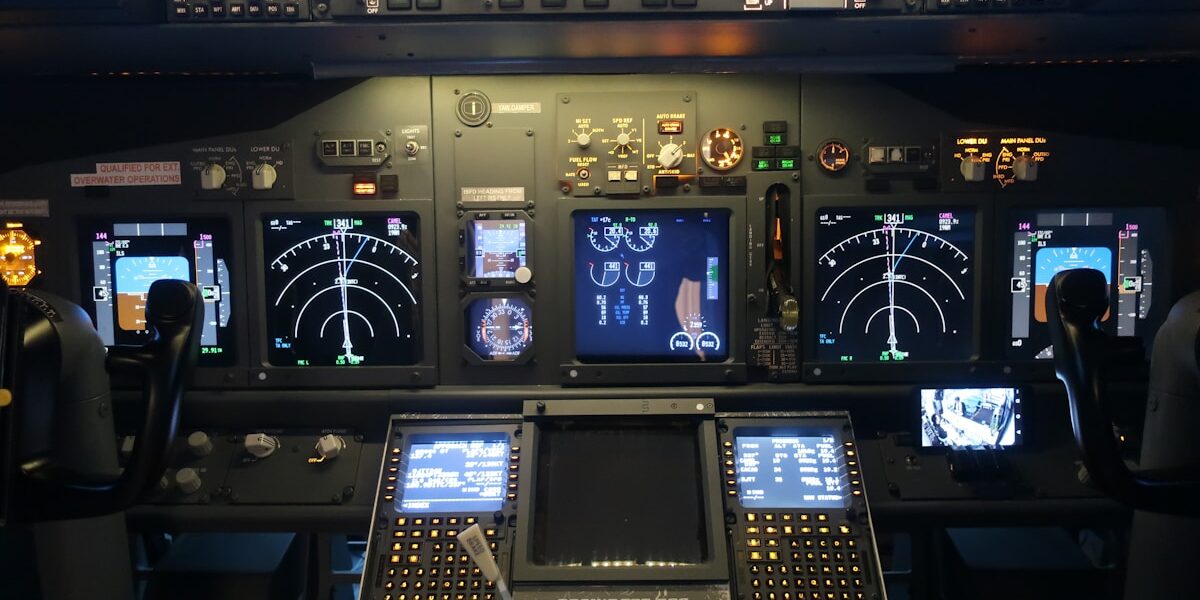
The Automatic Direction Finder (ADF) represents one of aviation’s foundational navigation technologies. While GPS has become the dominant navigation tool in modern aircraft, ADF systems remain relevant for backup navigation, certain instrument approaches, and as required equipment on many aircraft. Understanding how ADF works provides insight into both aviation history and practical navigation skills.
How ADF Technology Works

ADF is a radio navigation system that determines the direction to a ground-based Non-Directional Beacon (NDB) or commercial AM broadcast station. The system uses low and medium frequency radio signals (190-1750 kHz) to provide bearing information to the pilot.
The Basic Components
Ground Equipment: Non-Directional Beacons (NDBs)
NDBs are simple transmitters that broadcast a continuous carrier signal along with a Morse code identifier. They transmit omnidirectionally—in all directions equally—hence “non-directional.” The signal travels along the ground and follows the Earth’s curvature, making NDBs effective at longer ranges than VHF systems in certain terrain.
Aircraft Equipment
- Receiver: Tunes to NDB frequencies and processes the incoming signal
- Loop antenna: A directional antenna that rotates to find the signal null point
- Sense antenna: Resolves the 180-degree ambiguity inherent in loop antennas
- ADF indicator: Displays the relative bearing to the station
The Direction-Finding Process
The loop antenna has a figure-eight reception pattern. When oriented broadside to the transmitter, signal strength is maximum. When aligned with the transmitter, the signal nulls (minimum strength). The ADF system automatically rotates the loop to find the null and thus determine direction.
The sense antenna eliminates ambiguity about which end of the loop points toward the station, ensuring the needle always points TO the station rather than away from it.
Reading ADF Indications
Relative Bearing Indicator (RBI)
The simplest ADF display shows the needle pointing to the station relative to the aircraft’s nose. If the needle points to 030°, the station is 30 degrees to the right of the nose. This requires mental math to determine the actual magnetic bearing TO or FROM the station.
Formula: Magnetic Bearing TO station = Magnetic Heading + Relative Bearing
Radio Magnetic Indicator (RMI)
More sophisticated aircraft use an RMI, which combines a heading indicator with ADF (and often VOR) needles. The RMI card rotates with the aircraft’s heading, so the needle automatically shows the magnetic bearing to the station. This significantly reduces pilot workload.
ADF Navigation Techniques
Homing
The simplest technique: keep the needle pointing straight ahead. Turn to keep the ADF needle on the nose, and you’ll eventually reach the station. However, if there’s a crosswind, homing produces a curved path and longer flight time.
Tracking
More efficient than homing, tracking involves establishing a wind correction angle to maintain a constant bearing to or from the station. This produces a straight ground track despite wind.
To track inbound:
- Turn to place the needle on the nose
- Note any drift (needle moving left or right)
- Turn into the wind and establish a correction angle
- Adjust until the needle position remains constant relative to the correction angle
Intercepting a Bearing
ADF allows you to intercept specific bearings to or from an NDB, similar to VOR navigation but requiring more active calculation since relative bearing must be converted to magnetic bearing.
ADF Instrument Approaches
Some airports, particularly smaller fields and international locations, still have NDB approaches. These non-precision approaches use the NDB for lateral guidance while the pilot controls descent based on altitude and distance checkpoints.
NDB approaches are considered among the more challenging instrument procedures because:
- No electronic glide slope guidance
- Subject to signal bending and interference
- Require continuous mental calculation (with RBI displays)
- More affected by wind than localizer or GPS approaches
Limitations and Errors
Night Effect
At night, the ionosphere reflects medium-frequency signals back to Earth. The aircraft may receive both the direct wave and reflected sky wave, causing erratic needle behavior. This error is most pronounced at dawn and dusk.
Terrain Effect
Mountains, large buildings, and other terrain features can reflect or refract NDB signals, causing bearing errors.
Electrical Interference
Thunderstorms generate significant electrical activity in the frequency range used by NDBs. The ADF needle will often point toward thunderstorm activity rather than the selected station—useful for weather avoidance but problematic for navigation.
Coastal Refraction
Radio waves bend when crossing a shoreline at an angle, causing bearing errors when flying over coastal areas.
Station Passage
As the aircraft passes directly over an NDB, the needle swings rapidly from pointing ahead to pointing behind. The area directly over the station creates unstable indications called the “cone of confusion.”
Modern Relevance
Why ADF Still Matters
Despite GPS dominance, ADF remains relevant for several reasons:
- Backup navigation: GPS jamming and solar events can affect satellite navigation; ADF provides an independent backup
- Regulatory requirements: Some airspace and approaches still require ADF capability
- International operations: Many countries maintain extensive NDB networks
- Knowledge foundation: Understanding ADF helps pilots grasp fundamental navigation concepts
The Declining Network
The FAA has been decommissioning NDBs as GPS coverage makes them redundant. Many training aircraft no longer include ADF equipment. However, the technology isn’t disappearing entirely—it remains part of the IFR navigation system and is still tested on FAA knowledge exams.
Practical ADF Skills
For pilots who fly ADF-equipped aircraft or operate internationally, key skills include:
- Tuning and identifying NDB stations (Morse code recognition)
- Converting relative bearing to magnetic bearing
- Tracking to and from NDBs in wind
- Intercepting specified bearings
- Executing NDB approaches
- Recognizing and compensating for ADF errors
The ADF represents elegant simplicity in navigation—a rotating antenna finding the direction to a radio signal. While newer technology has largely superseded it, the fundamental concepts of radio navigation that ADF embodies remain foundational to understanding how aircraft find their way across the sky.




Stay in the loop
Get the latest flighttechtrends updates delivered to your inbox.