Airbus A220 vs Embraer E195-E2 Passenger Comparison
What These Two Jets Actually Compete On
The Airbus A220 vs Embraer E195-E2 debate has gotten complicated with all the airline marketing noise flying around. As someone who has spent an embarrassing number of hours cross-referencing seat maps at midnight before booking flights, I learned everything there is to know about these two aircraft. Today, I will share it all with you.
But what is this rivalry actually about? In essence, it’s two jets fighting over the same thin-route territory. But it’s much more than that. Both seat somewhere between 100 and 150 passengers depending on configuration. Both go after routes where a full narrowbody is overkill and a turboprop is an insult to anyone traveling with a roll-aboard. If you fly regularly between mid-sized cities — US, Europe, South America — your odds of landing on one of these jets are climbing fast. The real question is which one you’d rather sit in for the next two hours.
So, without further ado, let’s dive in.
Cabin Width and Seat Comfort Side by Side
Probably should have opened with this section, honestly. Because everything downstream — noise, ride quality, your general mood upon landing — starts with whether you’re crammed against a stranger or not.
I ended up deep in a FlyerTalk thread at 11pm once, trying to confirm whether my JetBlue booking from Boston to Raleigh was on an A220 or an older E190. That rabbit hole taught me more about fuselage width than I ever expected to care about. It’s not abstract engineering. You feel it in your shoulder, your elbow, your patience on a packed Tuesday afternoon departure.
The A220’s 2-3 Layout — and What It Actually Means
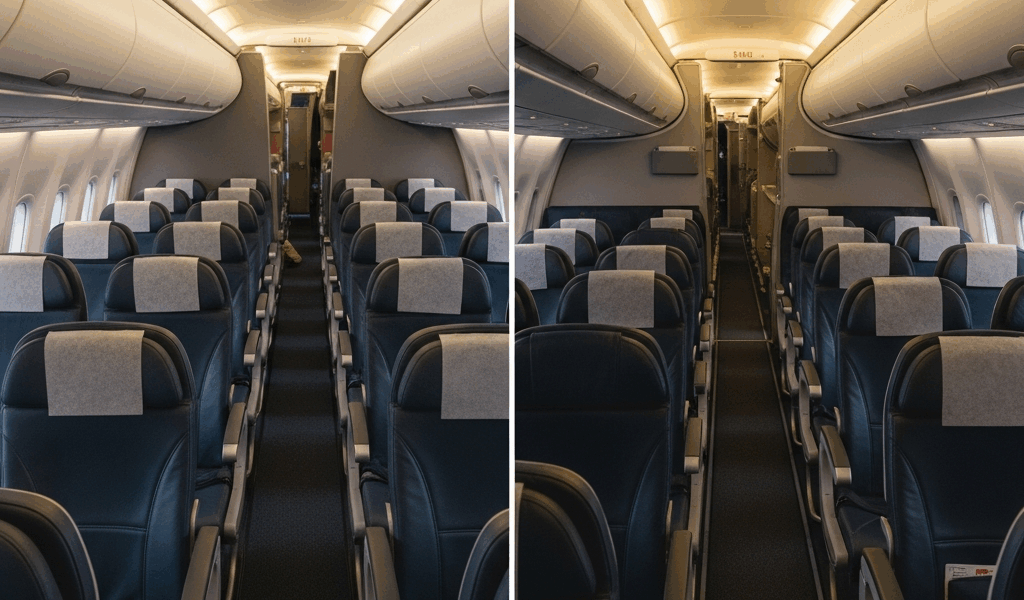
The Airbus A220-300 has a cabin interior width of roughly 104 inches. Airlines typically run a 2-3 seat layout — two seats on one side of the aisle, three on the other. Sounds simple. Then you get assigned the middle seat in the three-seat row and it stops sounding simple.
Seat width in economy runs around 18.5 inches depending on the carrier. Delta’s A220 configuration lands in the 18 to 18.5-inch range. The overhead bins are large enough for full-size carry-ons without the contortion act you perform on older regional jets — that alone earns goodwill from most passengers.
The window seat on the A220 is genuinely good. There’s fuselage curvature at shoulder level, yes, but the seat itself clears that curve cleanly in most configurations. You’re not leaning into the wall the way you do on smaller jets. The aisle is passable — a flight attendant can move the cart without making every aisle-seat passenger turn sideways. Not roomy. Passable.
The E195-E2’s 2-2 Layout — the Real Story
The Embraer E195-E2 runs a 2-2 seat layout. No middle seat. Full stop. That’s what makes the E2 endearing to us frequent flyers who’ve spent one too many hours negotiating armrest territory with strangers.
The fuselage interior is narrower — roughly 98 inches — but the absence of a middle seat rewrites the experience entirely. Standard economy seat width sits around 18 inches. Less than an inch narrower than the A220. In practice, that gap evaporates because you’re never the third person in a three-seat row.
Overhead bin space is tighter, though. The bins handle standard carry-ons, but the geometry isn’t as generous as the A220’s. On full flights, gate-checking bags becomes genuinely likely. Know that before you book.
Legroom on both jets comes down entirely to what the airline decides to do with seat pitch. The E195-E2 has been configured at 30 inches by some operators, 32 by others. JetBlue runs about 32 inches in standard economy on their A220s. Neither aircraft has a structural edge here. The airline decides. The airline usually decides to squeeze.
Noise and Ride Quality at Cruise Altitude
Here’s where the comparison gets harder to make cleanly — and honestly more interesting.
Both aircraft use variants of Pratt & Whitney’s PW1000G geared turbofan family. The A220 gets the PW1500G. The E195-E2 gets the PW1900G. Same GTF architecture, designed from the ground up to reduce noise at the source. Passengers on both jets consistently describe quieter cabins than older regional equipment powered by CFM56 or CF34 engines. If you’ve ever flown a first-generation E175 or a CRJ-700 and thought the engine noise was going to outlast your will to travel, both of these jets are a real upgrade.
Aviation forums — FlyerTalk, r/aviation — have scattered passenger reports calling the A220 particularly quiet. Some describe cruise altitude as “eerily calm.” The E195-E2 collects similar praise, just slightly less often. This could be sample bias. The A220 has broader deployment in North American markets where English-language aviation communities are most active, so it accumulates more reviews. Calling the A220 definitively quieter isn’t warranted based on current passenger data. Both are good.
Ride quality in turbulence is where I’d give the A220 a slight edge. The airframe uses composite materials extensively — about 46% of the structure by weight — and passengers on choppy hops over the Appalachians or across short North Atlantic segments report smooth ride characteristics. The E195-E2 handles turbulence well for its class. Neither aircraft rides like a widebody — they’re both narrow tubes — but the A220 seems to absorb bumps with a bit more mass behind it.
Which Routes You Will Find Each Aircraft On
JetBlue operates a significant A220-300 fleet across US domestic routes — Boston to various Southeast and Mid-Atlantic cities, JFK to smaller markets. Delta has been expanding its A220-100 fleet aggressively out of LaGuardia and Atlanta, covering segments where a 737-700 was previously overkill. Air Canada Jazz runs A220s on thinner transcontinental and cross-border routes. Swiss International Air Lines uses the type on European short-haul and occasional thin transatlantic segments — the A220 is ETOPS certified, which still surprises people when they find out.
Frustrated by limited jet options on domestic Brazilian routes, Azul Brazilian Airlines went all-in on the E2, building one of the largest E195-E2 fleets globally. This new idea took off several years later and eventually evolved into the dominant regional jet operation South American enthusiasts know and track today. KLM Cityhopper flies E195-E2s on European thin routes out of Amsterdam. Binter Canarias operates them across the Canary Islands. Porter Airlines in Canada has committed to a large E195-E2 order for transcontinental Canadian service — if you’re booking Porter in the next few years, E2 time is coming.
The A220 dominates North American mainline carrier fleets right now. The E195-E2 has stronger penetration in South America and select European regional markets. Both are growing.
Which One Is Better for Passengers — and When
Here’s the direct breakdown by situation.
Best for window seat comfort — A220. The wider interior puts the window seat farther from the fuselage curve at shoulder height, and the overhead bins are more accessible from that position.
Best for short hops under 90 minutes — E195-E2. The 2-2 layout kills the middle seat entirely. On a 75-minute flight between Philadelphia and Cincinnati, not negotiating an armrest matters more than almost anything else.
Best if you are tall — depends on the airline, not the aircraft. Both jets offer similar seat pitch ranges in economy. While you won’t need to hire a travel agent to figure this out, you will need a handful of resources — SeatGuru and individual airline seat maps are your actual friends here. The A220 has slightly more overhead cabin clearance due to the wider fuselage, which taller passengers notice when standing to retrieve bags.
Best if turbulence ruins your day — A220, marginally. Passenger accounts and the aircraft’s relative mass suggest slightly smoother handling in light to moderate chop. It’s not dramatic. Both jets are significantly better than the regional equipment they’re replacing.
I’m apparently someone who notices cabin noise immediately, and the A220 works for me while older CRJ-series jets never really did. Don’t make my mistake of booking whatever’s cheapest without checking the equipment type first — especially on a two-hour hop where the aircraft is the entire experience. Flying a CRJ-200 in 2012 and stepping onto a modern A220 or E195-E2 isn’t a subtle difference. It’s the difference between tolerating a flight and actually being okay with how it went. Either jet gets you there less exhausted than what came before. That part’s worth remembering before you spend too much energy arguing which one wins.



Stay in the loop
Get the latest flighttechtrends updates delivered to your inbox.