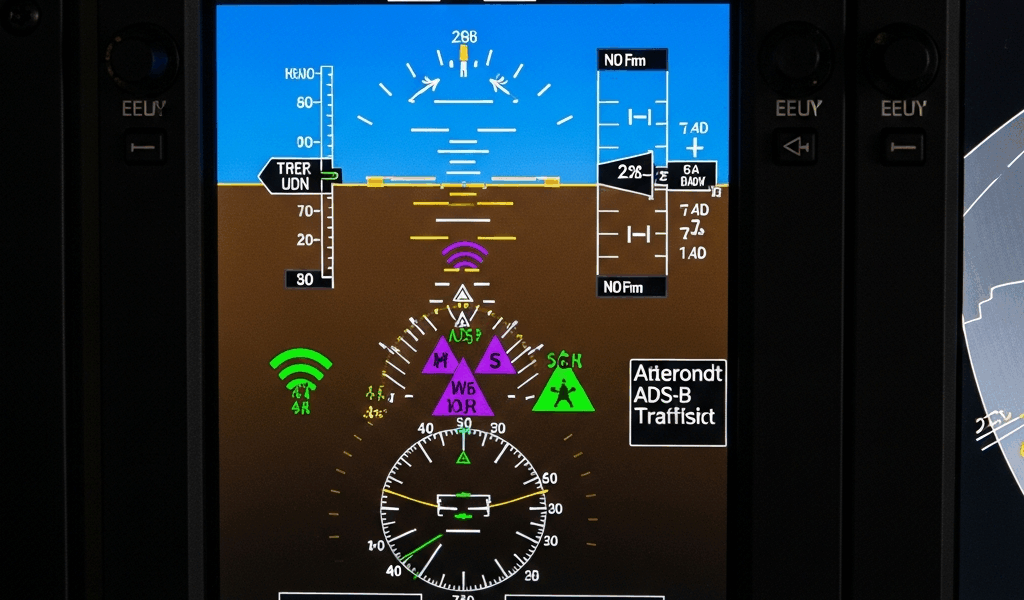
The U.S. House of Representatives passed the Airspace Location and Enhanced Risk Transparency (ALERT) Act of 2026 (H.R. 7613) Tuesday evening, 396–10. The bill sets a hard deadline of December 31, 2031 for ADS-B In equipage across virtually all aircraft already required to carry ADS-B Out. It now moves to the Senate — where the path is anything but clear.
For the hundreds of thousands of GA owners who installed ADS-B Out-only boxes to beat the January 2020 mandate — units like the Garmin GTX 335 (P/N 011-03300-40, ~$2,995 with WAAS GPS) or the uAvionix tailBeacon — this bill means a second compliance cycle is coming if it becomes law. Those boxes transmit 1090ES beautifully. They receive nothing.
What the Bill Actually Requires
The ALERT Act defines “covered aircraft” as turbine-engine aircraft required to have ADS-B Out, plus civil aircraft operating in Class B and Class C airspace and within their lateral boundaries up to 10,000 feet MSL. Already required to squitter out? You’d be required to receive in — full stop, by December 31, 2031.
The FAA gets two years from enactment to publish a final rule, and that rule must lock in the December 31, 2031 compliance date. Experimental and limited-category airworthiness certificate holders are exempt.
Airlines face an additional requirement: ACAS X. It’s the next-generation collision avoidance system that NTSB simulations showed would have given the crew of American Airlines Flight 5342 a few seconds more warning than existing TCAS II before the January 2025 collision near Reagan National that killed 67 people. The ALERT Act was a direct legislative response to that accident.
The GA Relief Valve — Portables May Qualify
Here’s the provision AOPA cheered. The bill explicitly requires the FAA to allow alternative means of compliance, including portable ADS-B In receivers displaying on an EFB or panel-mounted display. Stratus, Sentry, and similar devices could satisfy the mandate for Part 91 operations — pending how the FAA writes the final rule.
That’s the catch. Labor groups and ALPA have already flagged deeper concerns about the bill’s architecture: ACAS X, which the ALERT Act mandates for airlines, is not yet commercialized, cannot operate on the airport surface, and is inhibited at low altitudes. ALPA’s objection is not narrowly about portable devices — it’s that the bill pivots away from integrated ADS-B In in favor of a system that isn’t ready. NTSB simulation data backs that concern up.
“ALPA will not settle for 75 percent of a safety solution.” — ALPA President Capt. Jason Ambrosi
“We’ve issued safety recommendations like ADS-B In, over and over and over again, aimed at preventing just these kinds of collisions. Recommendations that have been rejected, sidelined or just plain ignored.” — NTSB Chair Jennifer Homendy
NTSB’s Core Finding — The 59-Second Number
NTSB determined that if Flight 5342 had been equipped with ADS-B In, the crew would have received a traffic alert 59 seconds before impact — versus the 19-second TCAS II alert they actually received. That 40-second delta is the technical foundation the entire bill is built on.
Senate — The Real Obstacle
Senate Commerce Committee Chairman Ted Cruz (R-TX) posted a pointed warning before Tuesday’s House vote:
“A warning to my colleagues in the House: the Alert Act would not deliver the safety measures necessary to prevent another midair collision, as it lacks the critical improvements our aviation system needs.” — Sen. Ted Cruz, posted on X
Sen. Maria Cantwell (D-WA) has also indicated the bill falls short. Both senators carry real leverage as chair and ranking member of the relevant Senate committees.
The competing ROTOR Act — which passed the Senate unanimously in December 2025 but failed a House floor vote in February 2026 at 264–133, short of the required two-thirds — remains a potential vehicle, either as a standalone bill or folded into an appropriations package.
Military equipage is also in play. The ALERT Act requires DOD aircraft to carry integrated ADS-B In by December 31, 2031, with ADS-B Out as the default operating mode for military helicopters in the NAS unless operational security requires otherwise. Pentagon spokesman Sean Parnell has flagged “unresolved budgetary burdens and operational security risks” — without specifying what they are.
What Owners Should Do Now
Nothing irreversible — yet. The bill still needs Senate passage and a presidential signature before the FAA rulemaking clock starts. But if you’re currently flying behind a GTX 335 or tailBeacon and an avionics refresh is anywhere in your near-term plans, ADS-B In capability should be on the requirements list. A panel-mount ADS-B In/Out combined unit would satisfy both mandates in a single box.
Watch the Senate markup process closely. The final rule’s definition of “alternative means of compliance” — specifically whether a Stratus on a kneeboard counts — will determine whether GA owners face a $300 portable purchase or a $4,000-plus panel installation.



Stay in the loop
Get the latest flighttechtrends updates delivered to your inbox.