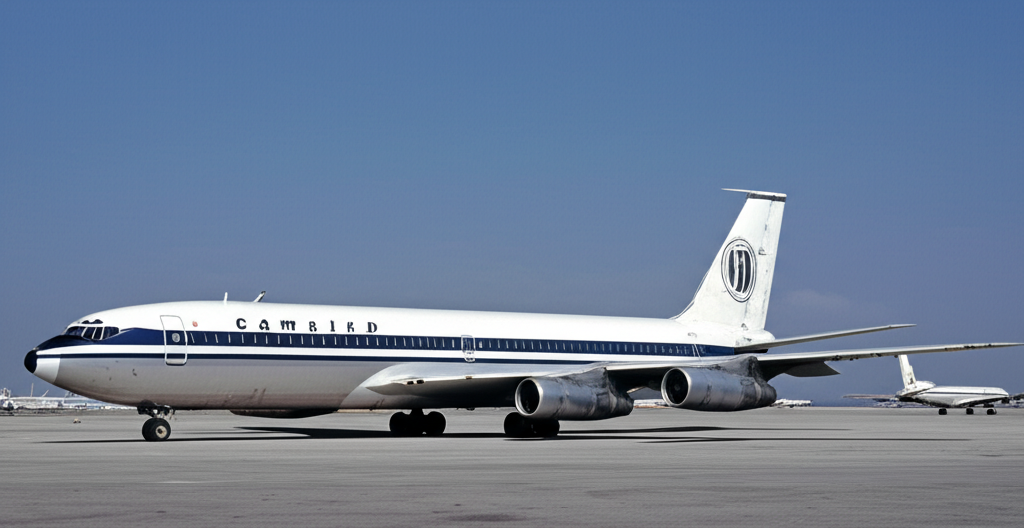
Commercial aviation history has a clear before and after, and the dividing line is October 1958. As someone who has spent considerable time studying how the modern aviation industry actually came to be, I learned that the Boeing 707 wasn’t just another new aircraft — it rewrote what commercial aviation meant. Today, I will share it all with you.
Before the 707
The propeller-driven aircraft that preceded the 707 — DC-6s, Constellations, and early Stratocruisers — were marvels of their time but fundamentally limited. A transatlantic crossing took 12–18 hours depending on routing and winds, required multiple fuel stops in some configurations, and offered a ride significantly rougher than modern jet travel.
The Comet, Britain’s de Havilland entry into the jet age, launched commercial jet travel in 1952 but was grounded after a series of catastrophic failures traced to metal fatigue around the square windows. The structural lessons from Comet disasters became foundational knowledge for aircraft design going forward — and Boeing incorporated every one of them.
What the 707 Did Differently
The 707’s defining characteristics were its four Pratt & Whitney JT3D turbofan engines, swept wing design, and high-altitude cruise capability. It could cross the Atlantic non-stop (or with a single fuel stop depending on direction and load), cruise at around 600 mph at altitudes above 30,000 feet, and carry 140–180 passengers depending on configuration.
The turbofan engines — as opposed to the turbojet engines on early jets — were more fuel efficient and significantly quieter. The swept wing’s 35-degree design reduced wave drag at cruise speeds and allowed the aircraft to operate comfortably near Mach 0.85, fast enough to fundamentally change trip times between continents.
The Economic Disruption
The 707 made transatlantic air travel affordable enough for the emerging middle class. In the 1930s and 1940s, ocean crossing was either a multiday ship voyage or an exclusive experience available to the very wealthy. By the mid-1960s, the 707 and its competition had dramatically expanded who could consider flying internationally.
Fares fell. Passenger volumes rose sharply. New routes became viable where the economics of propeller aircraft couldn’t support them. Airlines ordered jets aggressively, and those that didn’t fell behind. The aircraft also established Boeing as the dominant force in commercial aviation — a position built on the 707 and extended through every generation of Boeing airplanes since.
Technical Innovations That Became Standard
The 707 introduced or popularized several design features that became baseline in all subsequent jet transports.
Rear-mounted engine pods on pylons kept engines away from the fuselage, simplified fuel and electrical routing, improved cabin noise levels, and made engine removal and servicing easier. Pressurized fuselage for high-altitude cruise made flying at 35,000+ feet routine, minimizing weather impacts and taking advantage of favorable winds. Hydraulic flight controls became standard as the scale of the 707 made human muscle-only control impractical — paving the way for autopilot and fly-by-wire systems that followed decades later.
Military Legacy
The Boeing 707’s military variants have proven extraordinarily durable. The C-135 Stratolifter and its derivatives — most notably the KC-135 Stratotanker — entered service in 1957 and are still flying for the US Air Force today. The E-3 AWACS, E-8 J-STARS, and various intelligence-gathering platforms are all 707 derivatives.
No commercial aircraft type has had a longer military service life. The airframe’s longevity reflects both the soundness of its original design and the Air Force’s ability to upgrade systems while preserving the basic platform.
The 707’s Successors
Boeing’s own 727, 737, and 747 all drew from 707 technology and manufacturing knowledge. The 737, now in its 800/900/MAX variants, is a direct descendant conceptually — a shorter, more efficient twin-engine aircraft that Boeing wouldn’t have known how to design and build without the 707 program.
The 707 was retired from major airline service in the 1980s as the 747, DC-10, and L-1011 wide-bodies took over long-haul routes. A few cargo operators and specialty users flew 707 variants into the 21st century.



Stay in the loop
Get the latest flighttechtrends updates delivered to your inbox.