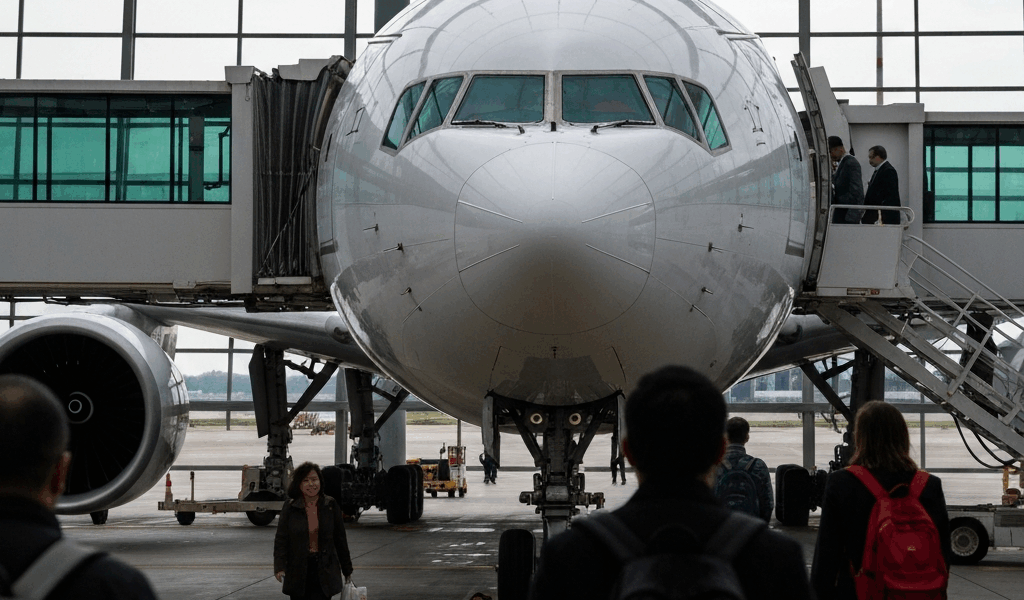
You booked a flight on a Boeing 777 and the confirmation says “777-200.” Then you see another departure on the same route listed as “777-300.” Same aircraft family, different experience. The difference is not subtle — it affects legroom, cabin pressure, route capability, and how crowded the aircraft feels.
The Size Difference: 63 Feet Matters
The 777-300 is 63 feet longer than the 777-200. That is the length of roughly 10 car lengths added to the fuselage. Boeing stretched the airframe to carry more passengers — the 777-300 seats 368 to 550 passengers depending on configuration versus 301 to 440 for the 777-200. More rows, same fuselage width.
From a passenger seat, the 777-300 feels different. The cabin is longer, boarding takes longer, and deplaning takes noticeably longer because there are 50 to 100 more people funneling through the same two exit doors. If you have a tight connection, the 777-200 gets you off the aircraft faster.
Economy Seat Pitch and Legroom
Seat pitch is set by the airline, not by Boeing, so both aircraft can have identical legroom if the airline configures them the same way. In practice, airlines often pack the 777-300 tighter. The extra fuselage length means more rows fit, and airlines frequently use that space for additional economy seats rather than spreading the existing seats out. Emirates runs 31-inch pitch in economy on both variants. United runs 31 inches on the 777-200 and squeezes to 30 on some 777-300ER configurations. Check your specific airline and route.
Seat width is identical on both — the fuselage cross-section is the same 20-foot diameter. Both aircraft fly 3-3-3 in economy (nine abreast) on most carriers, though some have gone to 3-4-3 (ten abreast), which shrinks each seat from about 18.5 inches to 17 inches. That difference is immediately obvious to anyone with shoulders wider than a teenager.
Routes: Where Each Aircraft Flies
The 777-200ER has a range of roughly 7,700 nautical miles — enough for New York to Hong Kong nonstop, London to Singapore, or Los Angeles to Sydney. The 777-300ER has slightly less range at about 7,370 nautical miles due to its heavier airframe, but airlines still use it on ultra-long-haul routes because it carries enough passengers to make the economics work.
In practice, you will find the 777-200 on thinner routes where demand does not fill the larger aircraft, and the 777-300 on high-demand trunk routes — Dubai to London, Tokyo to Los Angeles, Singapore to Sydney — where passenger volume justifies the larger cabin.
Business and First Class Differences
The 777-300ER is where airlines install their flagship premium cabins. The extra fuselage length gives room for suites, lie-flat pods, and premium economy sections without sacrificing as much economy revenue. Emirates’ famous first-class suites with closing doors fly exclusively on the 777-300ER. Singapore Airlines’ new business class with direct aisle access is on the 777-300ER.
The 777-200 tends to carry older cabin products on many airlines — airlines invest their newest interiors in their newest or largest aircraft first. There are exceptions, but if you are booking premium travel and care about having the latest seat product, the 777-300ER is usually the better bet.
The Verdict: What Passengers Should Actually Care About
The aircraft variant matters less than the airline’s specific configuration on that variant. A 777-200 with 31-inch pitch in economy beats a 777-300 crammed to 10-abreast with 30-inch pitch. Check SeatGuru or the airline’s seat map before booking — it tells you more about your actual experience than the aircraft type alone. If you have a tight connection, prefer the 777-200 for faster deplaning. If you want the newest premium cabin product on a long-haul flight, the 777-300ER is usually where airlines put their best seats.




Stay in the loop
Get the latest flighttechtrends updates delivered to your inbox.