Carbon Fiber in Aviation — Why Modern Planes Use Composites
Carbon fiber aviation has gotten complicated with all the engineering jargon and corporate marketing noise flying around. As someone who spent three years obsessing over aerospace materials after a single long-haul 787 flight left me genuinely confused about why I felt human when I landed, I learned everything there is to know about composites in commercial aircraft. The windows were enormous. My skin wasn’t the texture of old parchment. Something was different — and I needed to know why. That sent me down a rabbit hole of maintenance manuals, FAA certification documents, and more YouTube footage of autoclave curing than my wife thought was reasonable. Here’s what actually matters, minus the chemistry lectures.
What Carbon Fiber Actually Is — Skip the Chemistry
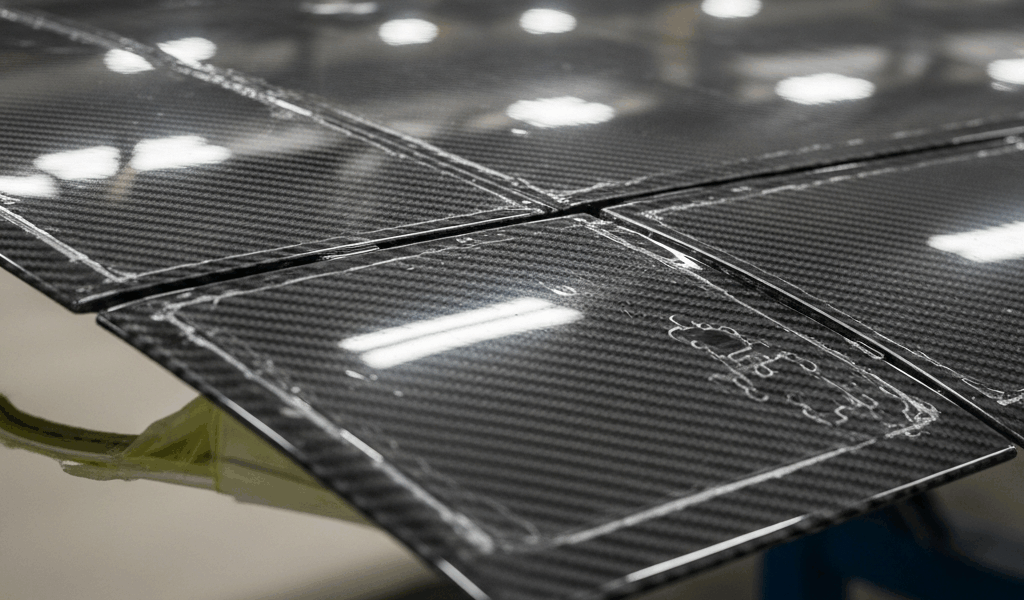
But what is carbon fiber composite? In essence, it’s a layered system of woven carbon fabric sheets, stacked at deliberate angles, soaked in epoxy resin, then baked under heat and pressure until the whole assembly becomes one rigid structure. But it’s much more than that. Think of it like plywood — except instead of wood grain, you’ve got fibers thinner than a human hair, and instead of wood glue, you’ve got aerospace-grade epoxy that costs more per kilogram than some used cars sitting in driveways right now.
The fiber orientation is where the real engineering lives. Technicians lay each layer at a precise angle — 0°, 45°, 90° — depending on the stress the part needs to handle. A wing skin sees completely different forces than a fuselage panel, so the layup schedule — the specific stacking sequence — gets custom-engineered for each component. Getting that layup wrong is the kind of mistake flagged immediately in quality control. Learning that fact made me appreciate why aerospace composites cost what they do.
The weight-to-strength numbers are genuinely impressive. Carbon fiber composite runs roughly five times stronger than steel by weight, about twice as stiff as aluminum for the same mass. A fuselage panel weighing 100 pounds in aluminum might weigh 60 pounds in carbon composite — and actually perform better under load. Across an entire aircraft, those savings stack into something that fundamentally changes both the design and the fuel burn.
Probably should have opened with this section, honestly. But it helps to know why you care before you learn what the thing actually is.
How Much of Your Plane Is Composite?
This is where specific numbers tell the real story — and the variation between aircraft families is pretty dramatic.
The Boeing 787 Dreamliner
The 787 is the benchmark. Boeing made a deliberate, risky call to push composite content to approximately 50% of the aircraft’s structural weight. Not 50% of surfaces or paint area — half the structural mass. The fuselage gets built in large barrel sections made entirely from carbon fiber composite, wound around a mandrel in a process producing a one-piece structure without the rows of fasteners you’d find on any aluminum fuselage. The 787-8 entered service with All Nippon Airways in October 2011, after a painful three-year delay — partly because manufacturing that much composite at that scale turned out to be considerably harder than anyone fully anticipated. Lesson learned the expensive way.
The Airbus A350 XWB
Airbus pushed even further. Composite materials account for approximately 53% of the A350 airframe by weight, making it the most composite-heavy widebody in commercial service right now. Wings, fuselage panels, tail surfaces, floor beams — all composite. Airbus uses flat-pressed fuselage panels rather than Boeing’s barrel-wound approach, but the result is comparable. The A350-900 has been flying since 2015 and has accumulated enough hours that operators are starting to understand the real-world maintenance picture — which we’ll get to.
The Boeing 737 MAX
Here’s the contrast. The 737 MAX, controversy aside, is fundamentally a 1960s airframe with updated engines. Composite content sits around 11 to 12% by structural weight — mostly secondary structures, control surfaces, and fairings, not primary structure. Don’t read that as a failure of engineering ambition. It’s a consequence of building on an existing certified platform where changing primary structure would require essentially a new type certificate. The 737 family’s economics depend on commonality with older variants, and that commonality comes at a material cost. Literally.
Other Notable Aircraft
- The Airbus A380 uses composites for roughly 22% of its structure — significant for its era, though it entered service in 2007 before the big composite push really hit.
- The Bombardier C Series — now flying as the Airbus A220 — uses composites for about 46% of the airframe, which is impressive for a narrowbody aircraft.
- Military platforms like the F-22 Raptor and B-2 Spirit push composite content above 70%, though cost constraints that would kill a commercial program simply work differently in defense procurement.
Why Not Make Everything Composite?
This is the question that gets answered with carefully worded non-answers in press releases. The real tradeoffs are more interesting than “we’re always evaluating materials technology.”
Repair Is Genuinely Hard
When aluminum gets dinged, a trained sheet metal technician can often assess the damage visually, compare it against allowable damage limits in the Structural Repair Manual, and fix it with tools that fit in a standard shop. Composite repair requires a different skillset entirely — different equipment, more complex damage assessment, and a process that takes longer. Damage in composite structures often propagates internally — delamination between layers that looks like absolutely nothing from the outside. Detecting it requires ultrasonic inspection gear or thermography. A technician can tap the surface with a coin and listen for a dull thud indicating delamination — the coin tap test, apparently still a real thing — but subtle internal damage needs proper NDT equipment. Not every maintenance facility around the world has that gear or those trained technicians, and that’s a real operational constraint for airlines flying into smaller outstations.
Lightning Strike Protection Costs Weight
Carbon fiber composite conducts electricity — just not well enough to safely disperse a lightning strike the way aluminum does. Aluminum basically acts as its own Faraday cage. Composites need a supplemental protection layer — usually a fine metal mesh or expanded foil embedded in the outermost ply of the laminate. On the 787, that system adds weight back, partially offsetting the savings from going composite in the first place. It works — the 787 has a solid lightning strike record — but it’s not free, and it’s not simple.
Inspection Opacity
This one is striking precisely because of how counterintuitive it is. That smooth, seamless composite fuselage surface looking so clean from the jetway actually hides its damage history better than aluminum would. A dented aluminum panel tells you a story. A composite panel that took a hit from a catering truck might show nothing externally while harboring internal damage affecting structural integrity. That requires more systematic scheduled inspections using equipment that line maintenance teams don’t always have ready access to during a quick turnaround in Reykjavik at midnight.
The Cost Equation
Raw carbon fiber prepreg — resin-impregnated fabric kept in refrigerated rolls before layup — runs somewhere between $15 and $30 per pound depending on specification. Aerospace-grade aluminum sheet stock runs closer to $2 to $5 per pound. Manufacturing labor for composite parts is also substantially higher. The payoff comes over the aircraft’s service life through fuel savings — the 787 burns roughly 20% less fuel per seat than the 767 it replaced — but upfront cost per aircraft is higher, and the total cost of ownership calculation is genuinely complicated. Don’t let anyone tell you it’s straightforward.
How Composites Change the Passenger Experience
Frustrated by a 13-hour work trip I couldn’t reschedule, I paid attention to every detail of that 787 cabin using a cheap notebook and handwritten observations made somewhere over the North Atlantic. The differences are real — and they trace directly back to the composite structure.
Higher Cabin Pressure
Aluminum fuselages fatigue faster under pressurization cycling. Every climb to altitude followed by a descent stresses the metal. To extend service life, aluminum-fuselage aircraft pressurize to an equivalent altitude of about 8,000 feet inside the cabin. Carbon fiber composite handles pressurization cycles with far less fatigue concern — so the 787 can pressurize to the equivalent of 6,000 feet. That 2,000-foot difference matters. Your blood oxygen saturation stays higher, fatigue comes slower, and those dull headaches from mild hypoxia show up less. Not a placebo — it’s measurable physiology.
Larger Windows
The 787’s windows are 65% larger than those on comparable aluminum aircraft. Composite fuselages distribute loads differently than aluminum skins with frames and stringers — you can cut larger openings without the same structural penalty. The windows themselves are electrochromic — a button darkens the glass in five stages rather than a pull-down plastic shade — but the size itself is the composite dividend. That’s what makes the 787 window feel so different standing at the gate.
Better Humidity
Aluminum corrodes. Keeping cabin humidity above about 10 to 12% on a long flight would create enough condensation inside an aluminum structure to cause serious corrosion problems over years of service. So aluminum-fuselage aircraft keep cabin humidity aggressively low — sometimes under 5%, which is drier than the Sahara on a bad day. Composite fuselages don’t corrode, so the 787 runs cabin humidity at 15 to 16%. Your skin, eyes, and sinuses notice this difference on a ten-hour flight. Don’t make my mistake of attributing it to the airline. It’s the airframe.
None of this is marketing language. It’s materials science you actually feel in your body when you land — sitting in that seat, looking out a bigger window, arriving somewhere without feeling like you were vacuum-sealed in a tin can for half a day. That’s what makes the carbon fiber story in aviation worth understanding. It stopped being abstract engineering the moment I stepped off that flight feeling, against all reasonable expectations, like a functional human being.



Stay in the loop
Get the latest flighttechtrends updates delivered to your inbox.