
The Composites Revolution in Aviation
Composite materials have transformed aircraft design over the past two decades, enabling weight savings, improved aerodynamics, and novel structural configurations impossible with traditional aluminum construction. The Boeing 787 and Airbus A350, with their composite-majority airframes, represent the current state of the art, but development continues toward even greater composite utilization and new material systems that promise further improvements.

Understanding composites is essential for anyone involved in modern aviation, from maintenance technicians to design engineers. These materials behave differently than metals, requiring new approaches to manufacturing, inspection, and repair.
Current Composite Applications
Modern commercial aircraft use composites extensively throughout their structures. The Boeing 787 Dreamliner comprises approximately 50 percent composite materials by weight, including the fuselage, wings, and empennage. Carbon fiber reinforced polymer (CFRP) provides exceptional strength-to-weight ratio, enabling fuel efficiency improvements of approximately 20 percent compared to similarly sized aluminum aircraft.
Carbon Fiber Reinforced Polymers
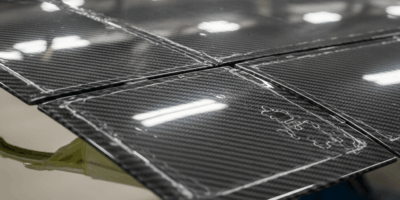
CFRP dominates structural applications where strength and stiffness are paramount. Carbon fibers provide exceptional mechanical properties while polymer matrices bind fibers together and transfer loads between them. Different fiber orientations and layup patterns allow engineers to tailor composite properties for specific loading conditions, an advantage impossible with isotropic metals.
Glass Fiber Applications
Glass fiber reinforced polymers remain important for applications where radar transparency is required, such as radomes and antenna fairings. Glass fibers cost less than carbon and provide good strength, making them appropriate for secondary structures and interior components.
Manufacturing Advances
Composite manufacturing has evolved substantially, with automated fiber placement and automated tape laying machines now producing large structures with precision impossible through hand layup. These technologies reduce labor costs while improving consistency and quality. Out-of-autoclave curing processes are expanding, reducing the need for massive autoclaves and enabling more distributed manufacturing.
Resin Transfer Molding
Resin transfer molding (RTM) and vacuum-assisted RTM enable production of complex net-shape components with excellent fiber volume fractions and surface quality. These processes are particularly suited for high-rate production of components like wing ribs and frames.
Thermoplastic Composites
Thermoplastic matrix composites are gaining importance in aerospace applications. Unlike thermoset composites that cure permanently, thermoplastics can be repeatedly heated and reformed, enabling welding and fusion bonding techniques that eliminate fasteners. Airbus has demonstrated welded thermoplastic composite fuselage sections that could revolutionize aircraft assembly.
Recycling Potential
Thermoplastics offer advantages for end-of-life recycling, as materials can be remelted and reformed. As environmental regulations tighten, the recyclability of aircraft materials is becoming an increasingly important consideration in material selection.
Inspection and Repair
Non-destructive inspection of composite structures requires different techniques than traditional metal inspection. Ultrasonic testing, thermography, and shearography are commonly employed to detect delaminations, porosity, and impact damage. Repair procedures for composite structures have been standardized, though repairs can be more complex than equivalent metal repairs.
Next-Generation Materials
Research continues into advanced composite materials with enhanced properties. Nanomaterial additives can improve matrix properties, increasing damage tolerance and electrical conductivity. Self-healing composites that automatically repair minor damage are being developed, potentially reducing maintenance requirements.
Ceramic Matrix Composites
Ceramic matrix composites (CMCs) are increasingly used in engine applications where extreme temperatures exceed polymer composite capabilities. These materials enable higher operating temperatures and reduced cooling requirements, directly improving engine efficiency. GE Aviation and other manufacturers are expanding CMC use in current and next-generation engines.
Industry Outlook
Composite utilization in aviation is expected to continue growing as manufacturing costs decrease and design experience accumulates. Future aircraft concepts envision even higher composite content, with novel configurations like blended wing bodies that composites uniquely enable.



Stay in the loop
Get the latest flighttechtrends updates delivered to your inbox.