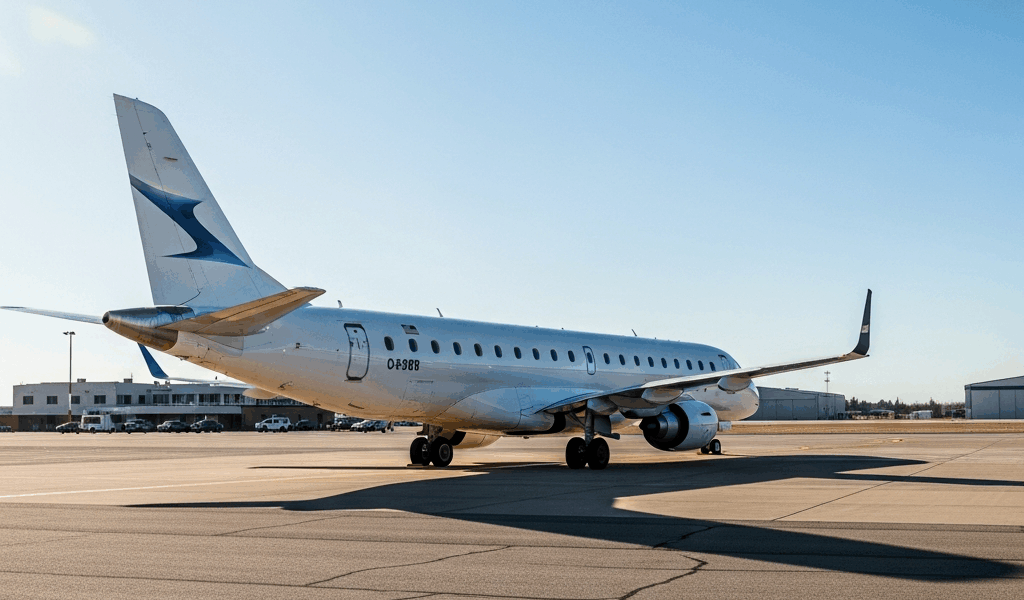
You board a regional jet for a two-hour flight and the aircraft feels cramped, the overhead bins barely fit a carry-on, and you are wondering why this route does not get a real airplane. That regional jet is probably an Embraer E175. The full-size jet you are comparing it to in your head is probably a Boeing 737. The gap between them is real, but it is not always as bad as your first impression suggests.
Cabin Width and Seat Layout
The E175 has a 2-2 seat configuration — two seats on each side of the aisle. No middle seat. Every passenger gets either a window or an aisle. The 737 runs 3-3 — three seats on each side, and someone always ends up in the middle.
This is where the E175 actually wins for some passengers. Seat width on the E175 runs about 18 inches, comparable to 737 economy. But with no middle seat passenger pressing against your arm, the personal space feels larger despite the narrower fuselage. If you are flying solo and want guaranteed aisle or window access without paying for seat selection, the E175 delivers that automatically.
Legroom and Seat Pitch
Seat pitch on the E175 typically runs 31 to 32 inches — slightly better than most 737 domestic configurations, which have dropped to 30 to 31 inches on many U.S. carriers. The E175 seat pitch advantage is real but modest. You will not confuse it with first class, but your knees are slightly less likely to touch the seat in front of you.
First class is where the aircraft diverge significantly. E175 first class seats are 21 inches wide in a 1-2 configuration. 737 first class runs 21 inches in 2-2 but with more recline and a wider cabin. The E175 first class is adequate for a two-hour flight but cramped for anything longer.
Overhead Bins and Carry-On Storage
This is the E175’s biggest weakness. The overhead bins are smaller than 737 bins and cannot accommodate standard full-size carry-on bags in many configurations. On full flights, passengers in the back half of the cabin frequently gate-check bags because there is no bin space left. If carrying your bag on board matters to you, board early on an E175 or accept the gate check.
The 737’s bins — especially on the 737-800 and 737 MAX with their larger overhead compartments — swallow full-size roller bags without issue. This single difference is the most consistent passenger complaint about regional jets versus mainline aircraft.
Routes and When You Get Each Aircraft
Airlines deploy the E175 on routes that cannot fill a 737 profitably — smaller cities, lower-demand time slots, spoke routes feeding a hub. The aircraft seats 76 passengers in typical U.S. configurations versus 160 to 189 on a 737-800. If your route connects a small city to a major hub, you are likely on an E175 operated by a regional carrier under the mainline airline’s brand.
The 737 flies trunk routes — hub to hub, high-demand city pairs, routes with enough passengers to fill 160+ seats. Same airline brand, different aircraft, different operating carrier in many cases.
The Verdict: Which Experience Is Better?
For flights under 2.5 hours, the E175 is surprisingly competitive — 2-2 seating with no middle seat is a genuine comfort advantage, and the slightly better seat pitch helps. For anything longer, the 737 wins on cabin pressure comfort, overhead bin space, and cabin width. If your route offers both aircraft on different departures, check the seat map and pick based on your priority: guaranteed window/aisle (E175) or overhead bin space and a bigger cabin (737).


Stay in the loop
Get the latest flighttechtrends updates delivered to your inbox.