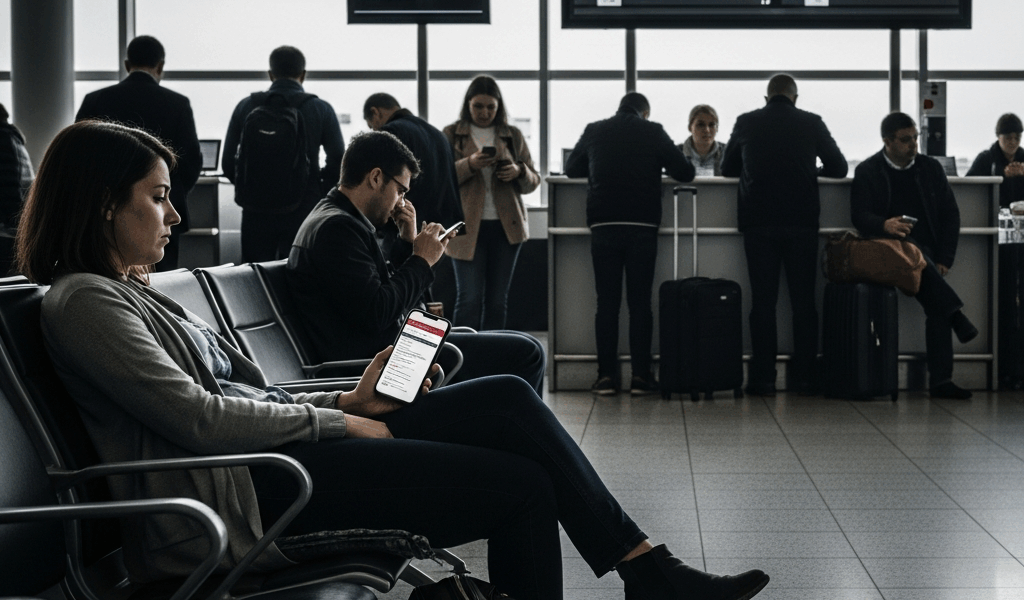
Flight Delay Compensation Services — Which Companies Actually Get Results
Flight delay compensation has gotten complicated with all the conflicting advice flying around. As someone who got stranded in Frankfurt for six hours back in 2019 — Brussels Airlines, a Tuesday afternoon, nothing but a lukewarm gate announcement and silence — I learned everything there is to know about these third-party claim services the hard way. Filed directly with the airline myself. Got a form rejection letter three weeks later. Then I started actually paying attention. Since then I’ve tracked how AirHelp, ClaimCompass, and MYFLYRIGHT operate, read through hundreds of Trustpilot reviews, and spoken to travelers who’ve used all three. Here’s what I found.
How Flight Delay Compensation Services Work
But what is a flight delay compensation service, exactly? In essence, it’s a no-win, no-fee middleman that handles your airline claim from start to finish. But it’s much more than that.
You submit your flight details. They evaluate eligibility. If your delay qualifies, they take over all correspondence with the airline — formal submissions, follow-ups with legal teams, escalations to national enforcement bodies, and if the airline keeps stalling, court or arbitration. Airlines treat a letter from AirHelp’s legal department differently than an angry email from a passenger. That’s the whole point.
The fee comes out of whatever they recover — typically 25% to 35%. Under EU Regulation 261/2004, payouts are fixed by statute. Under 1,500 km and delayed more than three hours? €250 per passenger. Between 1,500 and 3,500 km? €400. Over 3,500 km and delayed more than four hours? €600. Those numbers don’t budge. So a 35% fee on a €250 payout is €87.50 gone. Real money. Whether that’s worth it depends entirely on how complicated your case is.
You never speak to the airline directly. During the claims process you sign a digital power of attorney — hands them authority to act on your behalf from that point forward. Straightforward cases on cooperative airlines can resolve in four to six weeks. Contested cases where the airline disputes liability? Six months isn’t unusual. Sometimes longer.
EU261 vs US DOT — Which Delays Are Actually Claimable
Probably should have opened with this section, honestly. A significant chunk of people submit claims they were never entitled to file.
EU Regulation 261/2004 — and its post-Brexit UK counterpart, UK261 — is the legal framework that makes all of this possible. It applies in two specific situations:
- Your flight departed from an airport in the EU or UK, regardless of which airline operated it
- Your flight arrived at an EU or UK airport, but only if the airline is registered in the EU or UK
Read that second point again. United Airlines, Chicago to London Heathrow, four-hour delay — no EU261 claim. United isn’t an EU-registered carrier and the departure was on US soil. The arrival being in the UK doesn’t save you here, because UK261 only extends that protection to non-UK carriers on inbound routes when those carriers are EU or UK registered. United is not. You’re out.
Fly British Airways on that exact same Chicago-to-Heathrow route under identical circumstances? Different story entirely. British Airways is UK-registered, Heathrow is in the UK — the US departure point doesn’t disqualify you when the carrier holds EU or UK registration. That’s what makes the carrier’s home jurisdiction so consequential.
US domestic delays run under a completely different set of rules — US DOT regulations. The DOT requires refunds on canceled flights and significant delays where the passenger opts not to travel, but there’s no fixed compensation structure equivalent to EU261. No €250 floor. No €600 ceiling. No automatic entitlement to anything beyond a refund. None of the services in this article touch US DOT claims, because those claims aren’t built the same way — they typically go directly to the airline or, in serious cases, the DOT itself.
If your delay happened entirely within the United States on a US carrier, these services cannot help you. Full stop.
AirHelp vs ClaimCompass vs MYFLYRIGHT — What Separates Them
Frustrated by the volume of contradictory information online, I cross-referenced Trustpilot scores pulled in Q1 2025, processing timelines reported by actual users, fee structures, and jurisdictional coverage before drawing conclusions. Here’s what the data shows.
AirHelp
AirHelp is the largest player in this space — most recognizable name, biggest infrastructure. Their Trustpilot score sits at 4.4 out of 5 across roughly 180,000 reviews, which is a meaningful sample. Fee is 35%, which is on the higher end. They also offer an “AirHelp Plus” membership at around $24.99 per year — lowers the fee, adds some travel benefits. Casual flyers probably won’t recoup that membership cost. Frequent travelers might.
Where AirHelp pulls ahead is coverage. They operate across more than 35 countries with legal representation in most EU member states, the UK, Brazil, Turkey, and other outlying jurisdictions. Complex multi-leg claims — missed connections across different carriers — are where their infrastructure earns its keep relative to smaller competitors.
The complaint that shows up consistently in negative reviews: communication goes quiet when claims enter litigation. Users report weeks without updates on contested cases. Frustrating, but honestly somewhat endemic to the industry — not exclusive to AirHelp.
ClaimCompass
ClaimCompass charges 25% plus VAT — the most competitive pricing of the three on straightforward claims. Their Trustpilot score is 4.3 out of 5 across roughly 3,000 reviews. Smaller sample than AirHelp, but the pattern is consistent. Users report faster initial responses and a cleaner submission interface.
Coverage is narrower. ClaimCompass focuses almost exclusively on EU261 and UK261 — no meaningful legal presence in outlying jurisdictions. For most travelers with a standard EU departure or arrival delay, that narrowness is irrelevant. For unusual routing — a delayed flight into Morocco on a Spanish carrier, say — they may hit a wall they can’t climb over.
ClaimCompass might be the best option, as flight compensation requires keeping fees low on clean, uncomplicated EU261 cases. That is because the statute-fixed payouts don’t scale, so every percentage point of the fee is a fixed euro amount out of your pocket on a fixed recovery.
MYFLYRIGHT
MYFLYRIGHT is Hamburg-based and charges 29.75% on recovered compensation — sits between the other two on price. Trustpilot score of 4.2 out of 5 across roughly 8,000 reviews. They market themselves on speed, claiming an average eight-week processing time. That figure applies to uncontested claims — don’t take it as a universal guarantee.
What MYFLYRIGHT does better than either competitor is communication during the process. Multiple reviewers — unprompted, across different review periods — single out their status updates as the clearest in the industry. For travelers who hand over power of attorney and then spend months wondering if anything is happening, that transparency has genuine value. That’s what makes MYFLYRIGHT endearing to us anxious claimants who want to know where our case actually stands.
Coverage is solid across EU member states and the UK — less extensive than AirHelp for edge cases. Their sweet spot is mid-complexity claims. Delayed connection through Frankfurt or Amsterdam, for instance — complex enough that communication matters, not so exotic that AirHelp’s broader legal network becomes necessary.
When to Use a Service vs Claim Directly
Direct claims are free. Win, and you keep everything — €250, €400, €600, all of it. The process involves a formal written claim to the airline, citing EU261 or UK261 specifically, and stating the exact compensation amount the statute entitles you to. Templates exist. Done properly it takes about 45 minutes.
Some airlines process direct claims without much drama. EasyJet, Ryanair, and Wizz Air all have online portals that handle straightforward cases within a few weeks. First, you should try the direct route — at least if your claim is clean, involves an EU departure, and the delay clearly wasn’t weather-related. Don’t make my mistake. I was frustrated after the Frankfurt delay and handed my claim straight to a service without attempting direct submission first. Paid €87.50 in fees on a €250 recovery I probably could have kept entirely.
Use a service when:
- The airline has already rejected your direct claim and escalation without a solicitor is the next step
- The airline has gone into administration — services with legal infrastructure handle insolvency proceedings better than individuals can
- Your claim involves a missed connection across two separate airlines, which introduces real legal complexity
- More than three months have passed and the airline has simply gone quiet on you
- You don’t have the time or patience to draft and send multiple follow-up letters yourself
The fee is a complexity premium and a convenience charge. Pay it when the complexity justifies it.
What These Services Cannot Do
No service in this space can recover US domestic delay compensation — because there is no US domestic delay compensation in the EU261 sense. The structure doesn’t exist under US law. Delta delayed you four hours from Atlanta to Denver? Nothing to recover through AirHelp or anyone else. The airline might voluntarily offer a voucher. You cannot compel payment through any legal mechanism that resembles EU261. Those are just different worlds.
Extraordinary circumstances are the other hard wall. EU261 and UK261 both exempt airlines from compensation when the delay results from circumstances outside their control — weather, air traffic control decisions, security threats, political instability. That exemption has been litigated extensively, and some airline claims of “extraordinary circumstances” have been thrown out in court. Technical faults on aging aircraft, for example, don’t always qualify as extraordinary. But a genuine snowstorm grounding flights across an entire airport? That’s not producing compensation. A service can evaluate whether an airline’s extraordinary circumstances claim holds up legally — but if it does, they can’t override it.
While you won’t need a lawyer of your own, you will need realistic expectations about what the framework covers. A legitimate service will tell you upfront when your claim is unlikely to succeed. If a service promises a recovery on a weather-cancelled flight, that’s a red flag — either they plan to file a claim they know will fail, or they don’t understand the regulation they’re supposedly enforcing.
This new industry took off several years after EU261 came into force in 2004 and eventually evolved into the established service ecosystem travelers know and use today. It works within a specific legal framework — not around it. Understand where your delay fits inside that framework, match the service to your situation, and you’ll be fine. The rest is paperwork.

Stay in the loop
Get the latest flighttechtrends updates delivered to your inbox.