In January 2024, United Airlines quietly retired its last Boeing 737-300, sending to the boneyard one of the final “steam gauge” cockpits in major U.S. airline service. For decades, pilots had scanned those circular, analog instruments—each one a mechanical marvel of gears, gyros, and backlighting. Today, they stare at screens.
The glass cockpit revolution didn’t happen overnight. It took 40 years, billions of dollars in development, and a complete reimagining of how humans and machines interact at 35,000 feet. The result is the safest era in aviation history.

The Steam Gauge Era
Traditional aircraft instruments earned the “steam gauge” nickname for their industrial appearance—round dials with needles, reminiscent of Victorian-era pressure gauges. Each instrument served a single purpose: one for airspeed, another for altitude, separate gauges for engine parameters, fuel quantity, and navigation.
A typical Boeing 727 cockpit contained over 100 individual instruments, switches, and warning lights. Pilots developed elaborate scan patterns, moving their eyes across the panel in memorized sequences to monitor aircraft status. The workload was immense, and critical information could hide among the visual clutter.
These instruments were also mechanical nightmares. Attitude indicators relied on spinning gyroscopes. Altimeters used aneroid capsules that expanded and contracted with air pressure. Each instrument required regular calibration, and failures were common enough that aircraft carried backup systems—sometimes three deep.
The limitations became tragically apparent in accidents. Eastern Airlines Flight 401 crashed into the Florida Everglades in 1972 partly because the entire flight crew became fixated on a burnt-out landing gear indicator light, losing situational awareness as the aircraft descended into the swamp. The crew couldn’t see the big picture because there was no big picture to see—just dozens of individual data points scattered across the panel.
The First Glass: Boeing 767 and 757
Boeing and Rockwell Collins introduced the first commercial glass cockpits in 1982 with the Boeing 767 and 757. These aircraft replaced many round gauges with cathode-ray tube (CRT) displays—the same technology used in television sets of the era.
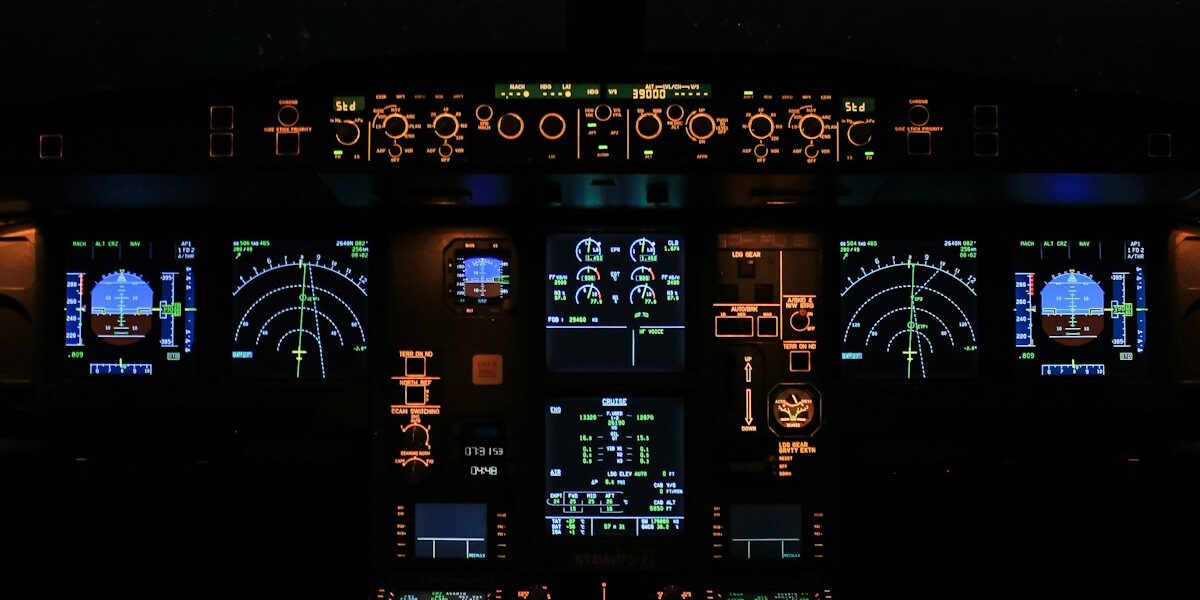
The transformation was dramatic. Instead of scanning dozens of separate instruments, pilots now viewed integrated displays that combined information logically. The Primary Flight Display (PFD) showed attitude, airspeed, altitude, and heading on a single screen. The Navigation Display (ND) presented a moving map with the aircraft’s position, route, and nearby traffic.
Engine instruments consolidated onto an Engine Indicating and Crew Alerting System (EICAS), which not only displayed current values but also highlighted abnormalities with color coding. Normal parameters appeared in green. Caution conditions showed in amber. Warnings flashed red.
The crew alerting system represented perhaps the biggest safety advancement. Instead of relying on pilots to notice a single gauge needle creeping into the red zone, the system actively monitored hundreds of parameters and announced problems with text messages and aural alerts.
LCD Revolution: The Modern Flight Deck
CRT displays had limitations—they were heavy, power-hungry, and generated significant heat. The switch to liquid crystal displays (LCDs) in the late 1990s enabled a new generation of glass cockpits with larger, brighter, more reliable screens.
Boeing’s 777, introduced in 1995, featured six large LCD panels arranged across the cockpit. Airbus’s A380, the double-decker superjumbo that entered service in 2007, pushed further with eight displays and the elimination of nearly all analog backup instruments.
Modern widebody cockpits like the Boeing 787 Dreamliner and Airbus A350 represent the current state of the art. These aircraft feature enormous landscape-format displays—up to 15 inches diagonal—that can be configured by crews to show whatever information they need most. The 787’s five displays can each show any function, providing redundancy if one screen fails.
Head-up displays (HUDs), once reserved for fighter jets, now appear in commercial cockpits. These project critical flight information onto a transparent screen in the pilot’s line of sight, allowing them to monitor instruments while looking outside during approach and landing.
What Pilots Actually See
Modern glass cockpit displays organize information into logical groupings:
Primary Flight Display (PFD): The central instrument showing the aircraft’s attitude (pitch and bank), airspeed, altitude, vertical speed, and heading. A flight director provides guidance bars showing the required pitch and bank to follow the programmed route or approach. Modern PFDs also integrate traffic alerts and terrain warnings directly into the display.
Navigation Display (ND): A moving map centered on the aircraft position, showing the programmed route, nearby airports, weather radar returns, and traffic. Pilots can adjust the range from 10 to 640 nautical miles and select various display modes depending on the phase of flight.
Engine Displays: Consolidated readouts of thrust settings, temperatures, fuel flow, oil pressure, and other engine parameters. Digital displays make trends immediately apparent—if an engine temperature is rising abnormally, the crew sees it instantly.
System Synoptics: Schematic diagrams of aircraft systems—hydraulics, electrical, fuel, pressurization—that show system status at a glance. Pilots can see exactly which pump is running, which valve is open, and where fluid is flowing.
The Safety Transformation
Glass cockpits contributed to a remarkable improvement in aviation safety. The U.S. fatal accident rate for commercial aviation dropped from approximately 0.05 accidents per 100,000 flight hours in 1980 to less than 0.002 today—a 25-fold improvement.
Several factors drive this improvement:
Reduced workload: Pilots spend less cognitive effort gathering basic information, freeing mental resources for decision-making and monitoring.
Integrated warnings: Systems actively alert crews to developing problems rather than relying on pilots to notice them during routine scans.
Situational awareness: Moving maps, traffic displays, and terrain databases give crews unprecedented awareness of their environment.
Automation integration: Glass displays work seamlessly with autopilots and flight management systems, making complex operations more manageable.
Training standardization: Digital displays can present information consistently across aircraft types, reducing training time when pilots transition between fleets.
Challenges and Controversies
The glass cockpit revolution hasn’t been without problems. Critics point to several concerns:
Automation dependency: Pilots raised on glass cockpits may have weaker manual flying skills. When automation fails, they must revert to basic instrument flying—a skill that requires practice to maintain.
Mode confusion: Modern autopilots have dozens of operating modes. Pilots occasionally misunderstand what mode the aircraft is in or what it will do next. Several accidents have involved crews fighting automation they didn’t understand.
Information overload: While glass cockpits reduce the number of instruments, they can present overwhelming amounts of data. Designers work constantly to filter and prioritize information appropriately.
Screen failures: Although rare, display failures can be more catastrophic than individual gauge failures. A single power supply problem could blank multiple screens simultaneously. Modern designs include extensive redundancy, but the vulnerability remains.
The Next Generation
Glass cockpit evolution continues. Emerging technologies include:
Touchscreen controls: The Airbus A350 was the first commercial aircraft with touchscreen-capable cockpit displays. Pilots can interact with systems by tapping and swiping, similar to tablets and smartphones.
Synthetic vision: Computer-generated terrain imagery gives pilots a clear view of mountains, valleys, and runways even in instrument conditions. The G1000 avionics suite, popular in general aviation, pioneered this technology.
Enhanced vision: Infrared cameras and millimeter-wave radar can see through fog, smoke, and darkness. Some business jets now offer combined enhanced and synthetic vision systems.
Augmented reality: Future systems may overlay navigation guidance, traffic, and terrain warnings directly onto the pilot’s view of the real world through augmented reality glasses or advanced HUDs.
The circular instruments that defined aviation for 80 years have given way to pixels and processors. Somewhere in museums and boneyards, the last steam gauges gather dust—monuments to an era when flying required reading 100 instruments instead of five screens.
The transition took four decades, but the glass cockpit revolution is complete. What comes next will be even more remarkable.


Stay in the loop
Get the latest flighttechtrends updates delivered to your inbox.