Electric planes! Hydrogen aircraft! Air taxis! Today, I’ll share what’s real, what’s coming, and what’s still science fiction.
Sustainable Aviation Fuel
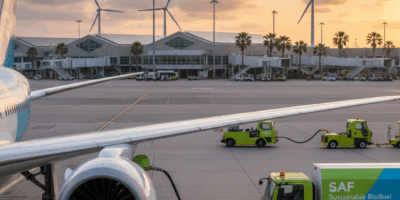
Before we get to the sexy stuff like supersonic jets and flying taxis, sustainable aviation fuel is the thing that’s actually making a difference right now. SAF is the industry’s best shot at cutting emissions this decade.
What Is SAF?
Sustainable aviation fuel is jet fuel made from stuff other than petroleum—used cooking oils, agricultural waste, municipal garbage, energy crops. The chemistry ends up similar enough to regular jet fuel that planes burn it without modifications.
Here’s the catch people miss: SAF still releases CO2 when burned. But since the feedstock plants absorbed carbon while growing, the lifecycle emissions drop 50-80% compared to drilling and refining petroleum. Some pathways using captured CO2 could theoretically go even lower.
Current State of SAF
Right now, SAF makes up less than 1% of global jet fuel. Why? It costs 3-5 times more than regular fuel. Airlines operate on razor-thin margins, so that price gap hurts.
But here’s what’s changing: major carriers have signed SAF purchase agreements worth billions of gallons over the next decade. That commitment gives producers confidence to build new facilities. European mandates and proposed requirements elsewhere will push adoption further.
Production Pathways
Several ways to make SAF exist, each with tradeoffs. HEFA (Hydroprocessed Esters and Fatty Acids) converts cooking oil into fuel—proven technology, but there’s only so much used fryer oil. Fischer-Tropsch synthesis can turn municipal waste into fuel—abundant feedstock, but expensive facilities.
Power-to-liquid uses renewable electricity to make hydrogen, which combines with captured CO2 to synthesize fuel. Virtually unlimited potential, highest emissions reductions, but currently the priciest option. Watch this space as renewable electricity keeps getting cheaper.
Electric and Hybrid-Electric Aircraft
Battery-electric propulsion will change short-haul flying. But physics sets hard limits on where it works.
The Battery Challenge
That’s what makes battery-electric aviation tricky for us aviation enthusiasts—the math just doesn’t work for big planes. Today’s best lithium-ion batteries store about 250 watt-hours per kilogram. Jet fuel? About 12,000. Even accounting for jet engine inefficiency, fuel delivers roughly 20 times more useful energy per kilogram.
Battery tech improves 5-8% annually. Solid-state batteries, lithium-sulfur, and lithium-air technologies could potentially double or triple energy density within a decade. But they need serious development before anyone certifies them for aircraft.
Electric Aircraft Today
Several companies are building and certifying electric planes for actual commercial use. The first offerings target short-range missions where battery limits are manageable—flights under 100 miles, payloads under 10 passengers.
Beta Technologies, Heart Aerospace, and Eviation have electric aircraft in development or certification. They’re going after regional routes, island-hopping services, and cargo operations where the mission fits current battery capability. United and JetBlue have placed orders.
Hybrid-Electric Approaches
Hybrid-electric designs combine turbine engines with electric motors. Parallel hybrids use both simultaneously; series hybrids use turbines to generate electricity for electric motors.
Airbus and Boeing are both exploring hybrid concepts. The most promising near-term application might be electric taxiing—wheel-mounted motors handling ground movement to eliminate ground fuel burn and reduce airport emissions and noise.
Hydrogen-Powered Flight
Hydrogen offers zero-emission propulsion without battery energy density problems. But it brings its own headaches.
How Hydrogen Aircraft Would Work
Two main approaches exist: burn hydrogen in modified gas turbines, or convert it to electricity in fuel cells driving electric motors. Combustion integrates more easily with existing aircraft designs; fuel cells promise higher efficiency but add complexity.
Here’s the interesting part: hydrogen’s energy density by weight actually beats jet fuel—33 kilowatt-hours per kilogram versus 12. The problem is hydrogen’s incredibly low density. You need to store it as cryogenic liquid at -253°C or as high-pressure gas, both requiring bulky tanks that eat into payload and range.
The Storage Challenge
Liquid hydrogen tanks must stay extremely cold throughout flight while insulating against heat. Tank volume runs roughly four times what equivalent kerosene tanks need, forcing major aircraft redesigns. This makes hydrogen most practical for short-to-medium-range aircraft where tanks fit in modified fuselage sections.
Airbus’s ZEROe concepts, targeting around 2035, include turboprop, turbofan, and blended-wing-body hydrogen aircraft for routes up to about 2,000 nautical miles. Longer-range hydrogen planes need storage breakthroughs.
Infrastructure Requirements
Hydrogen aircraft would need entirely new airport infrastructure—production facilities, storage tanks, delivery systems. Producing green hydrogen from renewable electricity takes significant power. Liquefaction adds energy overhead. Cryogenic fuel systems at airports mean major capital investments.
Expect hydrogen adoption to start at limited airport pairs where dedicated equipment makes economic sense, then gradually expand as costs drop and equipment standardizes.
Supersonic Flight’s Return
Twenty years after Concorde retired, multiple companies are developing supersonic aircraft that promise speed without the original’s environmental and economic baggage.
New Supersonic Designs
Boom Supersonic’s Overture aims to carry 65-80 passengers at Mach 1.7, cutting transatlantic flights to about 3.5 hours. Modern aerodynamics and engines deliver much better fuel efficiency than Concorde, though still worse than subsonic jets.
NASA’s X-59 Quesst is designed to produce a quiet thump rather than the disruptive boom that confined Concorde to overwater routes. If it works, supersonic overland flight becomes possible, dramatically expanding where these planes can actually fly.
Technical Challenges
Supersonic flight inherently burns more fuel than subsonic due to wave drag that spikes above Mach 1. Modern design tools and materials help, but physics imposes fundamental efficiency penalties.
Engine development is particularly tough. Concorde’s Olympus engines were optimized for supersonic cruise but wasted fuel at subsonic speeds during takeoff, climb, and descent. New supersonic engines must perform well across the entire flight envelope while meeting noise rules far stricter than Concorde faced.
Market Potential
Supersonic economics favor long routes where time savings justify premium pricing. Transatlantic, transpacific, and long Asian routes offer the biggest markets. Business travelers willing to pay significant premiums for time savings are the initial targets.
United has announced agreements to buy Boom Overture aircraft, with conditional orders from American and JAL suggesting industry confidence in supersonic’s comeback. If early operations work, larger orders could follow.
Urban Air Mobility
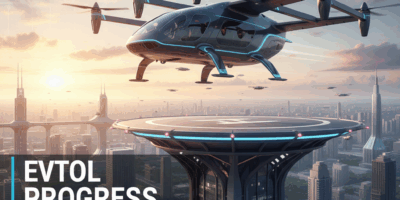
Electric vertical takeoff and landing aircraft—eVTOLs—promise to transform urban transportation as air taxis that skip ground traffic entirely.
eVTOL Technology
Electric motors powering multiple rotors or tilting propellers enable vertical flight without helicopter maintenance headaches. Battery limits restrict current designs to 30-100 miles, but that’s plenty for urban and suburban trips.
Joby Aviation, Archer Aviation, Lilium, and Wisk are developing eVTOL aircraft targeting certification within 2-3 years. These typically seat 2-4 passengers plus pilot (or fly autonomously) and should cost significantly less to operate than helicopters.
Operational Concepts
Picture networks of vertiports—helipad-like facilities around cities—connected by eVTOL flights. Book through an app, travel to a nearby vertiport, fly to your destination in minutes instead of sitting in traffic for hours.
Initial services will have pilots, transitioning to autonomous operation as regulations allow and public trust builds. Going pilotless dramatically improves economics since pilot costs eat a big chunk of helicopter operating expenses.
Challenges to Adoption
Beyond the technology itself, eVTOL faces real hurdles. Fitting into existing airspace means new procedures and systems. Noise, though much lower than helicopters, may still spark community opposition. Vertiports need major investment and tricky zoning approvals.
Battery life and charging time constrain how many flights each aircraft can make—time spent charging means no revenue. Fast charging stresses batteries and shortens their life. Swappable battery packs might help but add complexity and cost.
Autonomous Flight
Automation has gradually taken over more cockpit functions. Fully autonomous commercial flight raises technological, regulatory, and social questions nobody has fully answered yet.
Current State of Automation
Modern airliners essentially fly themselves for most of each flight. Autopilots follow routes, autothrottles maintain speeds, autoland systems touch down in zero visibility. Pilots mainly manage systems, monitor automation, and step in when things go sideways.
The remaining pilot functions—decision-making during abnormal situations, talking to controllers, providing final judgment—are the hardest to automate. These require flexibility, creativity, and contextual understanding that current AI lacks.
Cargo Before Passengers
Autonomous cargo aircraft will come before pilotless passenger flights. Lower stakes (no passengers if something goes wrong) and simpler missions (point-to-point freight without service requirements).
Reliable Aviation, Xwing, and others are testing autonomous cargo using modified existing aircraft. Ground-based pilots provide remote supervision while building experience and regulatory confidence.
Regulatory and Social Acceptance
Even with mature technology, regulatory approval for autonomous passenger aircraft will require extensive proof of safety exceeding current human-piloted operations. Given aviation’s excellent safety record, that’s a high bar.
Public acceptance might be equally challenging. Surveys consistently show passengers prefer human pilots, even when told autonomous systems might be safer. Building trust will take years of successful cargo and eventually supervised passenger operations.
Advanced Air Traffic Management
Current air traffic control systems, designed for far less traffic, limit aviation efficiency and capacity. Next-generation systems aim to fix that.
Space-Based ADS-B
ADS-B (Automatic Dependent Surveillance-Broadcast) lets aircraft broadcast GPS-derived positions, replacing radar for tracking. Ground stations receive ADS-B over land, but oceans had no coverage until satellite receivers enabled global tracking.
Satellite ADS-B allows closer oceanic spacing—down from 80-100 nautical miles to as little as 15 on equipped routes. More direct routing saves fuel and time while boosting capacity on crowded ocean tracks.
Trajectory-Based Operations
Future traffic management will coordinate entire flight paths rather than handing aircraft between sectors. Operators will negotiate optimal 4D trajectories (three spatial dimensions plus time) with traffic management systems for more efficient routing while maintaining separation.
This needs data sharing far beyond today’s systems. Implementation is happening incrementally through NextGen in the US and SESAR in Europe.
Advanced Materials and Manufacturing
New materials and production methods enable lighter, stronger, more efficient aircraft structures.
Composite Structures
Carbon fiber composites have progressively replaced aluminum, offering 20-30% weight savings with equal or better strength. The 787 and A350 use composite fuselages, wings, and tails, achieving significant fuel efficiency gains.
Next-generation thermoplastic composites promise faster manufacturing, better recyclability, and improved damage tolerance. Automated fiber placement and additive manufacturing keep reducing production costs.
Additive Manufacturing
3D printing has moved from prototyping to certified production parts. GE Aviation’s LEAP engine includes printed fuel nozzles that reduce weight, improve efficiency, and consolidate 20 separate parts into one.
Future applications may include larger structural components and engine parts currently made through casting and machining. Additive manufacturing enables shapes impossible to produce conventionally.
Timeline for Transformation
These technologies will transform aviation at different rates based on maturity, regulations, and economics.
Near-Term (2025-2030)
SAF production will scale significantly, potentially hitting 5-10% of jet fuel consumption. Electric aircraft will enter limited commercial service on short routes. eVTOL air taxis will launch in pilot cities. Space-based ADS-B and advanced procedures will improve oceanic efficiency.
Medium-Term (2030-2040)
New supersonic aircraft may enter service on premium transoceanic routes. Hydrogen aircraft could begin regional operations. eVTOL services may expand to multiple cities, potentially autonomous. Electric and hybrid aircraft will serve larger short-haul markets.
Long-Term (2040-2050)
Hydrogen propulsion may extend to medium-haul. Autonomous cargo will likely be routine, with pilotless passenger flights possibly starting on limited routes. SAF and hydrogen combined could dramatically cut aviation’s carbon footprint. Urban air mobility may become routine transportation.
Implications for Aviation Careers
These technologies will reshape aviation careers but probably won’t eliminate pilot jobs soon. New aircraft types need pilots trained on novel systems. Urban air mobility will create eVTOL pilot demand. Technology development needs engineers, scientists, and technicians.
The transition spans decades—conventional and new technologies operating together, requiring skills across both. Aviation professionals who embrace continuous learning and adapt to new technologies will thrive in the transformed industry.
The future of flight will be dramatically different—cleaner, faster, more accessible, more automated. Understanding these technologies prepares us for changes that will reshape not just aviation, but how societies connect and economies function.

Stay in the loop
Get the latest flighttechtrends updates delivered to your inbox.