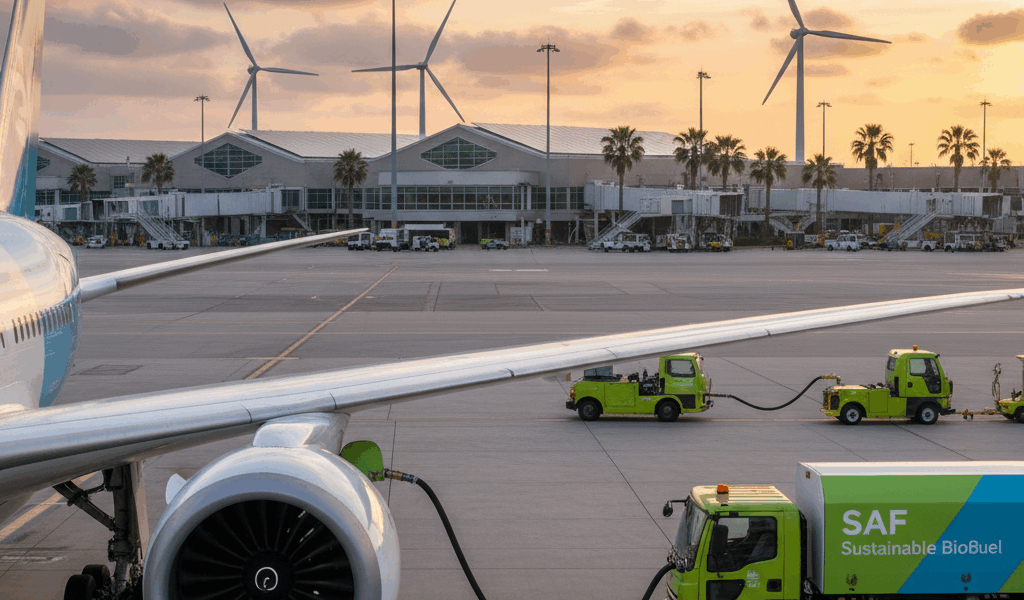
Aviation contributes approximately 2.5% of global carbon emissions, and with air travel rebounding strongly post-pandemic, the pressure to decarbonize has never been greater. Sustainable Aviation Fuel (SAF) has emerged as the industry’s primary solution—but the path from promise to reality is proving more challenging than expected.
Where SAF Stands in 2026
In 2025, global SAF production reached 1.9 million tonnes (2.4 billion liters)—double the previous year. While this sounds impressive, it represents just 0.6% of total jet fuel consumption worldwide.
The 2026 outlook shows continued growth but at a slower pace. Production is projected to reach 2.4 million tonnes, or approximately 0.8% of global jet fuel demand. This is still a tiny fraction of the 300+ million tonnes of conventional jet fuel consumed annually.

What Makes SAF “Sustainable”?
SAF isn’t a single product—it’s a category of aviation fuels produced from sustainable feedstocks. Common sources include:
- Used cooking oil and other waste fats
- Agricultural residues like corn stover and wheat straw
- Municipal solid waste
- Dedicated energy crops
- e-SAF (Power-to-Liquid): Synthetic fuel made from captured CO2 and green hydrogen
The carbon benefits come from the lifecycle—the CO2 released when SAF burns was recently absorbed by plants (unlike fossil fuels that release ancient carbon) or, in the case of e-SAF, was captured directly from the atmosphere.
Production Pathways and Their Challenges
Understanding SAF requires knowing the different production methods. The most mature pathway is HEFA (Hydroprocessed Esters and Fatty Acids), which converts waste oils and fats into jet fuel. This accounts for roughly 90% of current SAF production. However, feedstock availability limits HEFA’s scalability—there’s only so much used cooking oil in the world.
Fischer-Tropsch synthesis converts carbon-containing materials (municipal waste, agricultural residues) into liquid fuel through gasification. This pathway offers greater scalability but requires significant capital investment and has longer development timelines.
Alcohol-to-Jet (ATJ) processes convert ethanol or other alcohols into jet fuel. Companies like Gevo and LanzaJet are advancing this technology, which can use a wider range of feedstocks including captured CO2 from industrial processes.
The Cost Challenge
SAF’s biggest obstacle remains price. Currently, sustainable fuel costs two to five times more than conventional jet fuel. In mandated markets, the premium can be even higher.
In 2025 alone, airlines paid a collective premium of $2.9 billion for the limited SAF available. Of this, $1.4 billion reflected the standard SAF price premium over fossil fuel, with additional costs coming from regulatory compliance and trading schemes.
Until production scales dramatically and technology improves, SAF will remain a premium product that most airlines cannot afford to use at scale.
Breaking Down the Economics
The cost structure of SAF production reveals why scaling is so difficult. Feedstock costs typically represent 60-80% of production costs for HEFA-pathway SAF. As demand increases, these feedstocks face competition from other industries seeking to decarbonize, particularly road transport biodiesel producers.
Capital expenditure for new refineries ranges from $500 million to over $1 billion, with construction timelines of 3-5 years. Investors require long-term offtake agreements and policy certainty before committing such sums—conditions that current regulatory environments don’t consistently provide.
Airline Commitments Under Pressure
Many major airlines committed to using 10% SAF by 2030—a target that’s now looking increasingly difficult. As IATA (International Air Transport Association) recently noted: “SAF is not being produced in sufficient amounts to enable these airlines to achieve their ambition.”
This isn’t due to lack of will. Airlines made these commitments in good faith, but production simply hasn’t scaled as anticipated. Many carriers are now quietly reassessing their 2030 targets.
Case Studies in Airline SAF Adoption
United Airlines has been among the most aggressive SAF adopters, operating regular flights from Los Angeles using SAF blends and investing directly in producers like Fulcrum BioEnergy. Despite these efforts, SAF represents less than 1% of United’s total fuel consumption.
In Europe, KLM and Lufthansa have pioneered SAF usage, often partnering with SkyNRG and Neste for supply. Both carriers offer passengers the option to pay for SAF through carbon offset programs—though uptake remains modest.
Asian carriers face particular challenges. While Singapore Airlines and Cathay Pacific have made SAF commitments, the region lacks significant domestic production capacity, requiring expensive imports from European and American refineries.
Regulatory Mandates and Their Impact
The European Union and United Kingdom have introduced SAF blending mandates, requiring airlines to use minimum percentages of sustainable fuel. However, these regulations are proving problematic.
IATA warns that mandates without adequate supply create artificial scarcity, driving up prices without actually increasing production. The result: higher costs for airlines and passengers without commensurate environmental benefits.
Looking ahead, e-SAF mandates are approaching in the UK (2028) and EU (2030). These synthetic fuels face an even steeper cost curve—potentially up to 12 times the price of conventional jet fuel.
The Production Bottleneck
The fundamental challenge is building enough production capacity. SAF requires specialized refineries, feedstock supply chains, and distribution infrastructure. These take years to develop and billions in investment.
Current production growth is hampered by:
- Feedstock competition: Waste oils are also used for road transport biodiesel
- Infrastructure gaps: Limited refinery capacity for aviation fuel production
- Investment uncertainty: Changing policies make long-term planning difficult
- Technology maturity: Advanced pathways like e-SAF remain expensive
Bright Spots: Regional Partnerships
Despite challenges, meaningful progress is happening at regional levels. The California Air Resources Board (CARB) and Airlines for America (A4A) have committed to increasing SAF availability in California to 200 million gallons by 2035—enough to meet 40% of intrastate travel demand.
In Australia, Airbus and Qantas have invested up to $200 million to develop domestic SAF production, partnering with the Queensland Government and Jet Zero Australia on a new biofuel facility.
These regional initiatives, while modest in global terms, are proving that public-private partnerships can accelerate SAF development.
Emerging Production Hubs
Singapore is positioning itself as an Asian SAF hub, with Neste’s expanded refinery capable of producing 1.3 million tonnes annually. The strategic location allows efficient distribution across Asia-Pacific routes.
The United States, benefiting from Inflation Reduction Act incentives, has attracted significant SAF investment. Tax credits of up to $1.75 per gallon for qualifying SAF have catalyzed multiple project announcements, though most won’t reach production until 2027-2028.
The Path to Net Zero
IATA’s Fly Net Zero initiative commits airlines to net zero carbon by 2050. SAF is expected to contribute approximately 65% of the emission reductions needed—an enormous reliance on a fuel that currently represents less than 1% of supply.
This isn’t impossible, but it requires:
- Massive investment: Hundreds of billions globally in production capacity
- Policy consistency: Long-term regulatory frameworks that encourage investment
- Technology advances: Bringing down e-SAF costs from current levels
- Feedstock development: Scaling sustainable sources without competing with food production
What This Means for Travelers
For passengers, SAF development will likely mean:
- Higher ticket prices: SAF costs will be passed along, at least partially
- Carbon offset alternatives: Airlines offering SAF-based offset programs
- Green fare options: Premium tickets that include SAF usage
- Gradual improvement: Steady increases in SAF blending over time
The Bottom Line
SAF is essential for aviation’s decarbonization, but 2026 reveals the gap between ambition and reality. Production is growing but not nearly fast enough. Costs remain prohibitive for widespread adoption. Airline commitments are being reevaluated.
The technology works—SAF is proven and safe. The challenge is purely economic and logistical. Solving it will require sustained investment, consistent policy support, and realistic timelines that acknowledge the scale of transformation needed.
For an industry that moved from propellers to jets in a decade, scaling sustainable fuel production should be achievable. But it won’t happen overnight, and 2026 is a year of managing expectations while continuing the essential work of building a sustainable aviation future.




Stay in the loop
Get the latest flighttechtrends updates delivered to your inbox.