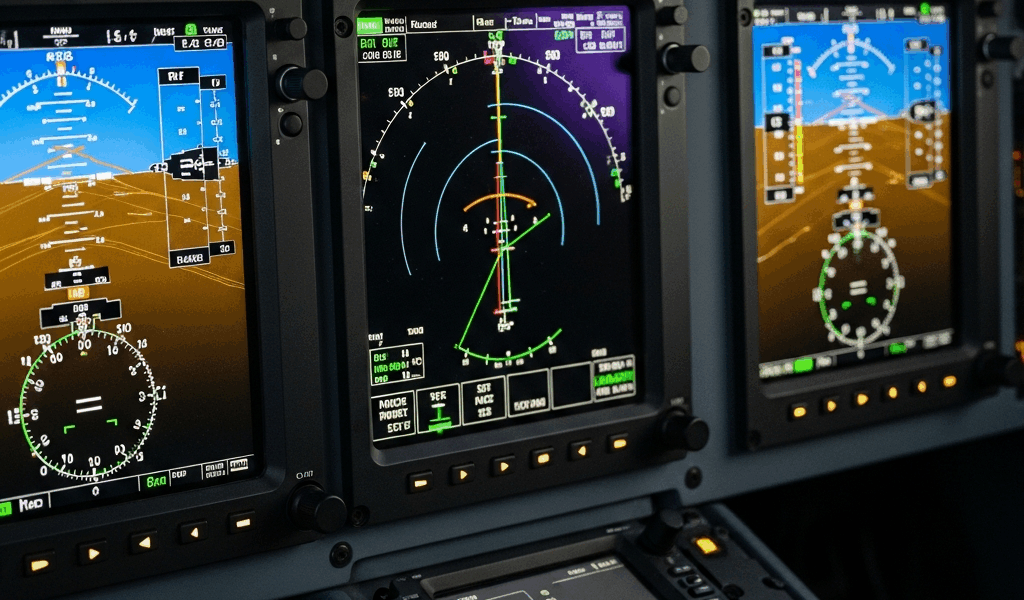
Garmin’s aviation segment just posted its strongest quarterly growth in recent memory. Revenue climbed 18% year-over-year to $263.8 million in Q1 2026 — reported April 29 — while operating income surged 47% to $71 million, delivering a 27% operating margin with gross margins holding at a remarkable 75%. Behind those numbers: two OEM wins that gave Garmin serious visibility heading into earnings season. The Daher TBM 980 launched with G3000 Prime as its flight deck, and the HondaJet Elite II received FAA certification for Emergency Autoland.
TBM 980 — G3000 Prime Takes the Flight Deck
Daher unveiled the TBM 980 on January 15 at its Tarbes, France production facility. The following week, the first two customer deliveries followed under simultaneous EASA and FAA certification. At $5.82 million, the aircraft is the sixth variant in the TBM 900-series — and the first production TBM to fly with Garmin’s third-generation G3000 Prime integrated flight deck. The incumbent TBM 960, equipped with the standard G3000 and priced at $5.62 million, continues in production for customers who prefer the current suite.
G3000 Prime is OEM-only. It will not be offered as a retrofit — Garmin received the relevant TSO from the FAA to manufacture and supply it to OEM partners, and that’s where it stays. TBM 960 operators can, however, add the Starlink Mini terminal that ships factory-standard on the 980.
The hardware step-up is substantial. Three 14-inch edge-to-edge multi-touch displays replace the prior generation’s screens, with processing power doubled and memory significantly expanded for faster refresh rates and smoother animations. The legacy touchscreen controllers are now 7-inch secondary displays with 40% more surface area. Garmin also retermed the display architecture: PFDs are now Primary Flight Windows (PFW), and the MFD becomes the Multifunction Window (MFW).
Pilot workload reduction was clearly the design brief. A new four-position joystick handles checklist scrolling and confirmation without menu-diving, while linked electronic checklists sense system state automatically. The app-based interface gives single-tap access to radios, transponder, flight plan, and procedures. Autoland has been updated in this generation to query NOTAMs before selecting a diversion airport — a meaningful safeguard that prevents an autonomous landing attempt on a closed runway.
Standard equipment rounds out an impressive list: GWX 8000 weather radar with StormOptix 3D storm profiling, dual WAAS GPS/NAV/COM/ILS, GTX 345 Mode S transponder with ADS-B In/Out, digital autopilot and autothrottle, and Garmin PlaneSync for remote aircraft monitoring and database management. A factory-installed 100-watt USB-C port powers the Starlink Mini cockpit terminal.
“Its touchscreen-controlled flight deck truly revolutionizes the interface between pilots and the avionics.” — Nicolas Chabbert, CEO, Daher Aircraft
More than 20 customers had placed commitments before the January reveal. The TBM 980 made its U.S. debut at Sun ‘n Fun in April — giving Garmin strong airshow visibility heading into the earnings print.
HondaJet Elite II — First Twin-Turbine VLJ with Emergency Autoland
On February 4, Honda Aircraft Company announced FAA certification of Emergency Autoland for the HondaJet Elite II. It became the ninth aircraft type approved for the system — and the first production twin-turbine very light jet to carry it. Certification flight testing wrapped in October 2025. The system integrates with the Elite II’s existing G3000 avionics suite and builds directly on the autothrottle certification Honda achieved in October 2024, which was a prerequisite for EAL approval.
From decision through rollout, the system operates autonomously. It evaluates weather, terrain, fuel state, and runway dimensions to select the best diversion airport, flies the approach, lands, and brakes to a full stop without pilot input. Honda is offering EAL on new production aircraft and actively exploring retrofit options for existing Elite II operators. International regulatory approvals are in progress.
“Adding Emergency Autoland to the HondaJet Elite II demonstrates our commitment to delivering new value to our customers.” — Hideto Yamasaki, President & CEO, Honda Aircraft Company
OEM Momentum Ahead of Aftermarket — But Both Growing
On the April 29 earnings call, Garmin CEO Clifton Pemble confirmed OEM deliveries were “definitely a strong contributor to the growth, stronger than the aftermarket side, although both contributed.” Aircraft manufacturer backlogs remain elevated — meaning OEM volume builds gradually, a tailwind Garmin expects to persist. Pemble framed the quarter as a continuation of long-term structural trends rather than a one-time spike.
The Autoland pipeline keeps expanding. The system is slated for certification on next-generation variants of the Cessna Citation CJ3 and CJ4, and Honda’s in-development HondaJet Echelon will ship with EAL from the factory. G3000 Prime has also been announced for the advanced air mobility market through BETA Technologies — a signal that Garmin is positioning the platform well beyond traditional Part 23 turbine aircraft.




Stay in the loop
Get the latest flighttechtrends updates delivered to your inbox.