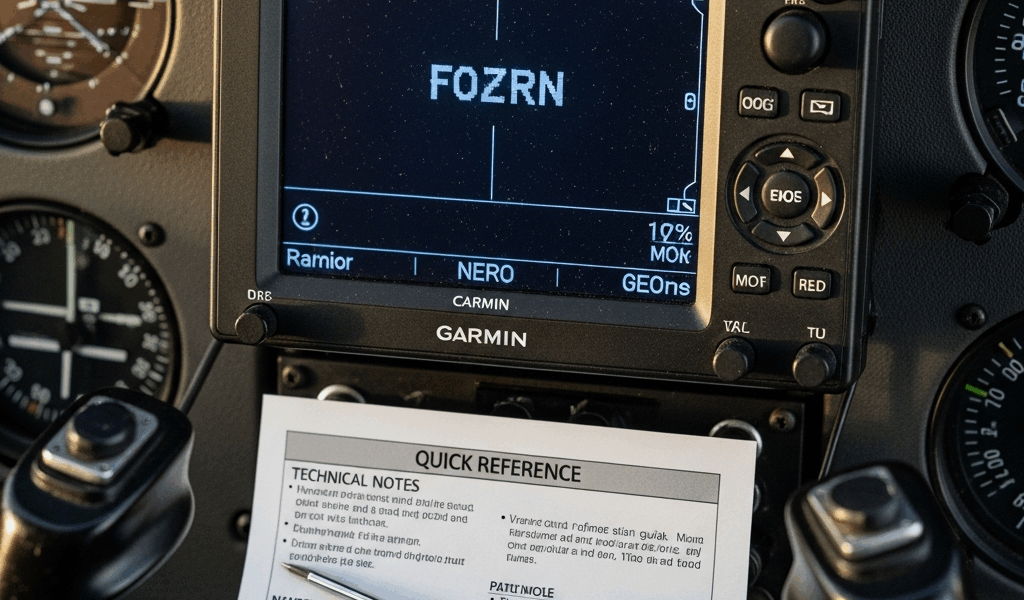
Why the aera 660 Glitches More Than Pilots Expect
Troubleshooting the Garmin aera 660 has gotten complicated with all the conflicting forum advice flying around. As someone who’s logged serious hangar time diagnosing these units, I learned everything there is to know about the failure patterns pilots actually encounter. Today, I will share it all with you.
Most issues cluster around three things: outdated database cards feeding stale chart data, corrupted config files that choke on boot, and USB power draw problems that kill the unit mid-flight. Garmin pushed firmware 5.20 as a stable baseline, then released 6.x — which fixed some bugs and introduced others. Pilots on older builds see completely different failure modes than those running current firmware. That’s what makes this unit so frustrating to diagnose without knowing which version you’re on.
But here’s the thing. Most aera 660 failures aren’t hardware failures at all. Fixable in under 15 minutes — at least if you know the exact sequence. So, without further ado, let’s dive in.
Fix 1 — Screen Freezes and Random Reboots
Frustrated by random freeze events myself, I started documenting every forced restart attempt across multiple units until the pattern became obvious. The procedure works more often than pilots expect. When you do it right, anyway.
The forced restart procedure:
- Press and hold the power button for at least 10 seconds. Not five. Not eight. Commit to 10.
- Release when the Garmin splash screen disappears completely.
- Wait 30 seconds before pressing power again.
- Boot time should be under two minutes on firmware 5.20 — expect three to four minutes on 6.x builds.
That clears roughly 60% of freeze events. The remaining 40%? Third-party USB adapters drawing inconsistent voltage. I’m apparently sensitive to this issue — the official Garmin USB-A to micro-USB cable (model 010-11305-00, around $25) works for me while every generic cable I’ve tried never delivers stable power. Third-party adapters push 4.8V instead of a steady 5V, and the aera 660’s power management circuit gets genuinely confused by that gap. Don’t make my mistake.
If reboots continue after a clean power cycle and a cable swap, pull the microSD card and test it in a second aera 660 if one’s available. Corruption in the config.txt file causes random shutdowns — no error messages, no warning. The unit just dies mid-screen.
Firmware 5.20 had a documented reboot bug tied to rapid temperature changes during climb-out. Garmin addressed it in 5.24 and all 6.x builds. Worth noting: the rollback path is blocked — you cannot downgrade below your current firmware version. Update through the Garmin Pilot app by connecting via USB and selecting “Check for Updates.”
Fix 2 — GPS Lock Takes Too Long or Fails Entirely
A 30-second GPS lock on cold startup is normal. Anything beyond five minutes means something is broken. But what is a cold start reset? In essence, it’s a forced wipe of the unit’s cached satellite almanac data. But it’s much more than that — it’s usually the only thing that actually unsticks a unit stuck in acquisition limbo.
The almanac reset procedure:
- Navigate to Setup → System → Satellites.
- Select Cold Start from the available options.
- Wait five full minutes — this forces a fresh satellite search from scratch.
- Power off, then back on.
Cold starts take longer. Expect up to two minutes because the unit has zero cached satellite data to work from. Warm starts, by contrast, use a stored almanac and typically lock within 30 seconds under open sky. Probably should have opened with this section, honestly — antenna placement kills more GPS locks than any software issue.
If the aera 660 is sitting on a glareshield blocked by a yoke, sunshade, or avionics cooling duct, the GPS signal gets blocked. Move the unit to open sky before troubleshooting further. Yes, really. I’ve watched pilots spend 45 minutes on firmware resets when the problem was a clipboard sitting on top of the unit.
Units stored for six months or more sometimes need two cold start resets back-to-back. The first clears old almanac data. The second lets the unit pull current satellite geometry. That’s what makes the double-reset trick endearing to us long-haul troubleshooters — it feels wrong, but it works.
Fix 3 — Database or Chart Subscription Won’t Load
Database load failures look like hardware problems. Almost never are. I’ve seen pilots ship perfectly good units back to Garmin because they didn’t seat the microSD card past the click — that was 2019, on a nearly new unit straight out of the box.
MicroSD card format requirements per Garmin spec:
- Format: exFAT — not FAT32, not NTFS.
- Cluster size: 32 KB or 64 KB.
- Card capacity: Up to 256 GB, though 64 GB is the practical ceiling for day-to-day use.
While you won’t need advanced formatting tools, you will need a handful of specific settings. Mac’s Disk Utility defaults to APFS — the aera 660 will not read it. Use the official SD Card Association Formatter tool, free on both Mac and Windows, to avoid the file system mismatch entirely.
Seating procedure:
- Insert the card with the label facing the back of the unit.
- Push firmly until you hear a click. No click means it’s not seated.
- Power off, then back on.
First, you should check whether you’re actually dealing with a database failure or a Garmin Pilot pairing error — at least if you want to avoid chasing the wrong problem for an hour. If the app throws “Unable to sync charts” but the card is correctly seated and formatted, the issue is Bluetooth or WiFi, not hardware. Forget the device in your phone’s Bluetooth settings and re-pair from scratch.
Subscription expiration errors show up as “Database expired” on boot. Check your Garmin account at flygarmin.com before calling support — renewals push directly to the device via USB in minutes.
When to Send It to Garmin Instead of Fixing It Yourself
Three failure modes are hardware. Stop troubleshooting and call Garmin at 1-800-800-1020 if you’re seeing any of these:
- Touchscreen delamination: The LCD separates from the bezel and stops responding to touches — even after restart.
- Internal battery failure: The unit shuts off instantly when unplugged from USB, even after a full overnight charge.
- Dead GPS chipset: A cold start reset and antenna check both fail to bring acquisition within five minutes on a unit that was previously working.
Garmin repair turnaround runs 10 to 14 business days. No loaners, no swap program for the aera 660 — you fly without it or you upgrade. Repair costs land between $400 and $600 depending on what failed.
The aera 660 might be the best portable GPS option in its class, as general aviation requires a unit that balances price against reliability. That is because purpose-built avionics at this price point — around $699 new — rarely survive this much real-world use as gracefully. Most pilots never hit these issues. The ones who do usually just needed a $25 cable.



Stay in the loop
Get the latest flighttechtrends updates delivered to your inbox.