Airbus A321XLR vs Boeing 737 MAX 10 — A Passenger’s Real Guide
Comparing these two jets has gotten complicated with all the spec-sheet noise flying around. Most of what you’ll find online is written for airline procurement officers, not people who actually have to sit in these things for eight hours nursing a warm ginger ale. As someone who has spent an embarrassing number of hours crawling through fleet announcements, seat maps, and cabin disclosure documents, I learned everything there is to know about how these planes actually feel from row 24. Today, I will share it all with you — and the honest truth is that for passengers, these two jets are more different than they look on paper.
What These Two Jets Actually Are
But what is the A321XLR? In essence, it’s Airbus’s answer to a very specific problem: how do you connect city pairs that don’t have enough demand for a widebody, but sit too far apart for a normal narrowbody? But it’s much more than that. We’re talking roughly 4,700 miles of range — enough to put Boston and Lisbon on a single aisle, or Chicago and Shannon without a connection in sight. Iberia, United, Scandinavian, and Wizz Air all have orders in. It entered service with Iberia in 2024.
The Boeing 737 MAX 10 is a different animal entirely. It’s Boeing’s longest, densest narrowbody — built to squeeze more seats onto short and medium routes where frequency beats luxury every time. American, United, and Southwest have it on order. It hasn’t entered commercial service as of this writing, still waiting on FAA certification. Think domestic trunk routes. Not transatlantic adventures.
Seat Width and Cabin Layout — Side by Side
Both jets run a 3-3 economy configuration. That’s where the similarity ends.
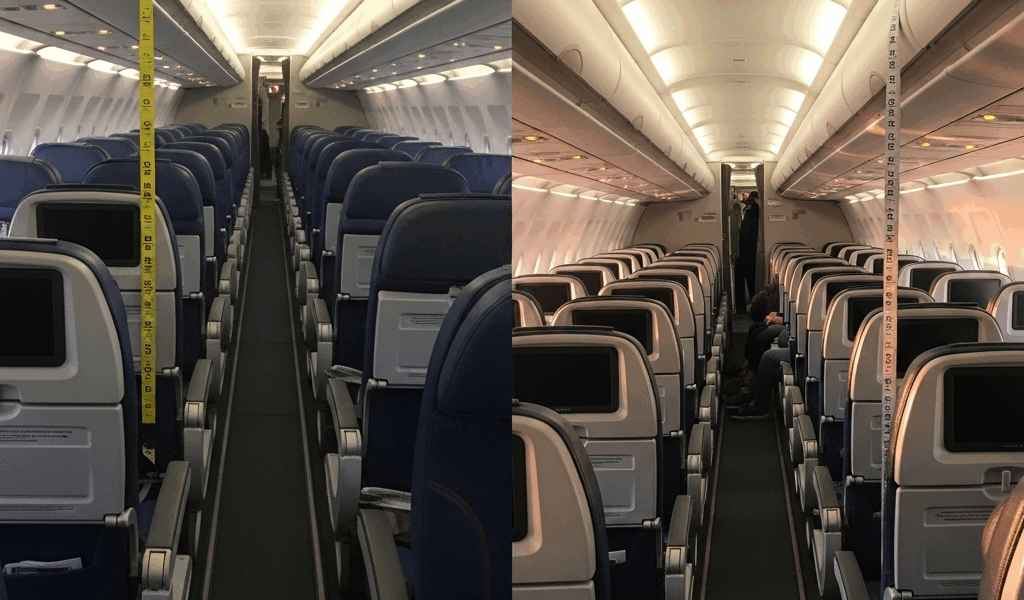
The A321 family has a wider fuselage — interior cabin width sits around 155 inches versus the 737’s 139 inches. Sixteen inches sounds abstract until you’re wedged into a middle seat somewhere over the North Atlantic for hour six. I’m apparently someone who notices these things immediately, and the extra width works for me while the tighter 737 cabin never quite lets my shoulders relax.
Economy seat width on the A321XLR typically lands between 17.7 and 18 inches depending on what seats the airline picked. Iberia’s configuration runs 18 inches wide at a 30 to 31-inch pitch. The 737 MAX 10, based on configurations filed for earlier MAX variants, delivers somewhere around 17 to 17.2 inches of seat width in economy — pitch in the 30-inch range on high-density domestic setups.
That’s roughly three-quarters of an inch per seat. Across six seats in a row, the Airbus cabin reclaims about 4.5 inches of total width distributed as shoulder room. Not transformative. But noticeable after hour three.
| Feature | Airbus A321XLR | Boeing 737 MAX 10 |
|---|---|---|
| Typical Economy Seat Width | 17.7–18 in | 17–17.2 in |
| Typical Seat Pitch (Economy) | 30–31 in | 28–31 in |
| Standard Economy Rows | ~28–32 | ~32–35 |
| Overhead Bin Style | Airspace XL bins (full-size roller fits flat) | Space Overhead bins (roller fits flat) |
| Cabin Layout | 3-3 | 3-3 |
The XLR’s Airspace cabin bins deserve a real mention. A standard 22-inch Travelpro Maxlite 5 fits flat, wheels-in, no shuffling required. The 737 MAX Space Overhead bins are genuinely improved over earlier 737 generations — but slightly more cramped by comparison. On a packed transatlantic departure where everyone’s carrying on a week of luggage, that difference matters more than you’d think standing in the jetbridge.
Cabin Noise, Ride Quality, and Windows
Frustrated by how little honest passenger data existed on XLR cabin noise specifically, I dug through every early Iberia report I could find from their mid-2024 revenue service launch. Here’s what’s actually known — and what isn’t.
Both jets use the CFM International LEAP engine family. LEAP-1A on the XLR, LEAP-1B on the 737 MAX. Both are quiet by narrowbody standards. The perceived cabin noise difference comes from fuselage insulation and interior architecture — not engine output.
The A321XLR’s Airspace cabin package includes improved sidewall panels and overhead bin assemblies that contribute to better sound damping than older A320-family variants. Early Iberia passengers generally reported a quieter ride than comparable narrowbodies. That said — and I want to be direct here — the XLR has only been in revenue service since mid-2024. There isn’t enough systematic data yet to give you a confident noise comparison against the MAX 10, which isn’t even certified yet. I’d rather flag that gap than fill it with speculation. Don’t make my mistake of trusting early forum posts as gospel.
The 737 MAX 10 uses the same Boeing Sky Interior found across the MAX family. Cabin noise is acceptable. Not remarkable. The windows are smaller than on a 787 or A350 — a legitimate complaint on longer legs where you actually want to see something outside besides cloud cover at 38,000 feet.
The A321XLR windows aren’t electrochromic dimmers either — no 787-style mood lighting here, just standard pull-shade windows. Neither jet wins a window war. But the A321XLR’s slightly larger window area does give you marginally more natural light on those long European legs. Small thing. Adds up over eight hours.
Which Routes Will You Actually Find These On
Probably should have opened with this section, honestly — route assignment is the most practical thing most passengers can actually understand and act on.
The A321XLR is doing something genuinely new. It’s opening transatlantic routes that have never existed at nonstop service levels before. Real examples either already flying or formally announced:
- Iberia: Madrid to Boston (already flying), Madrid to Washington Dulles
- United Airlines: Announced transatlantic routes from secondary U.S. cities — specifics still developing as of early 2025
- Scandinavian Airlines (SAS): Copenhagen to U.S. East Coast destinations
- Wizz Air: Abu Dhabi to European cities on extended-range missions
The pattern is clear — secondary city pairs that couldn’t economically support a 787 or A330. If you live somewhere that isn’t New York, Chicago, or Los Angeles, the XLR may eventually give you a nonstop to Europe that simply didn’t exist before. That’s what makes the A321XLR endearing to us frequent flyers who’ve spent years connecting through Frankfurt at 6 a.m.
The 737 MAX 10 will live almost entirely in domestic and short-haul international markets. American Airlines has it slotted for high-frequency domestic routes — Chicago to New York, Dallas to Denver, that kind of cadence. Southwest’s order targets their core domestic network. You will not be flying the MAX 10 across the Atlantic. That’s not a criticism. It’s just not what it was built for.
So if you see a MAX 10 on your booking, you’re probably on a two-hour domestic hop. If you see an A321XLR, you might be doing something genuinely unusual for a narrowbody — eight hours over open ocean in a plane with one aisle.
Which One Should You Hope Is on Your Flight
For domestic routes under three hours — honest answer: it doesn’t matter much. Both jets give you a 3-3 economy experience with tolerable seat widths and functional overhead bins. Three-quarters of an inch of seat width won’t ruin or save a Denver-to-Atlanta flight. Pick based on schedule and price and move on.
For medium-haul international routes in the four-to-six-hour range: lean toward the A321XLR if you have a choice. The marginally wider seat, the better bins, the quieter cabin architecture — they add up over that duration. Not dramatically. But enough that you’ll notice when you land.
For transatlantic legs — the XLR wins by default. The MAX 10 won’t be flying them. If you’re looking at a nonstop transatlantic route on a narrowbody, the A321XLR is almost certainly your plane. That’s a genuine passenger win, because the alternative used to be connecting through a hub on a widebody — which sounds luxurious until you’ve missed three connections at Frankfurt on a Tuesday in January.
One mistake I made early in tracking this: I assumed all A321 variants were the same plane with different stickers. They’re not. The A321neo, A321LR, and A321XLR have different fuel tank configurations and meaningfully different range capabilities. Always check the specific subvariant before assuming your flight is doing something interesting. To find out exactly which aircraft is on your booking, look up your flight on FlightAware or check the aircraft type in Google Flights — it’s listed in the flight details, usually as “321” with a subtype code your airline will specify.
Check before you book. Thirty seconds. Most useful thing in this entire article.



Stay in the loop
Get the latest flighttechtrends updates delivered to your inbox.