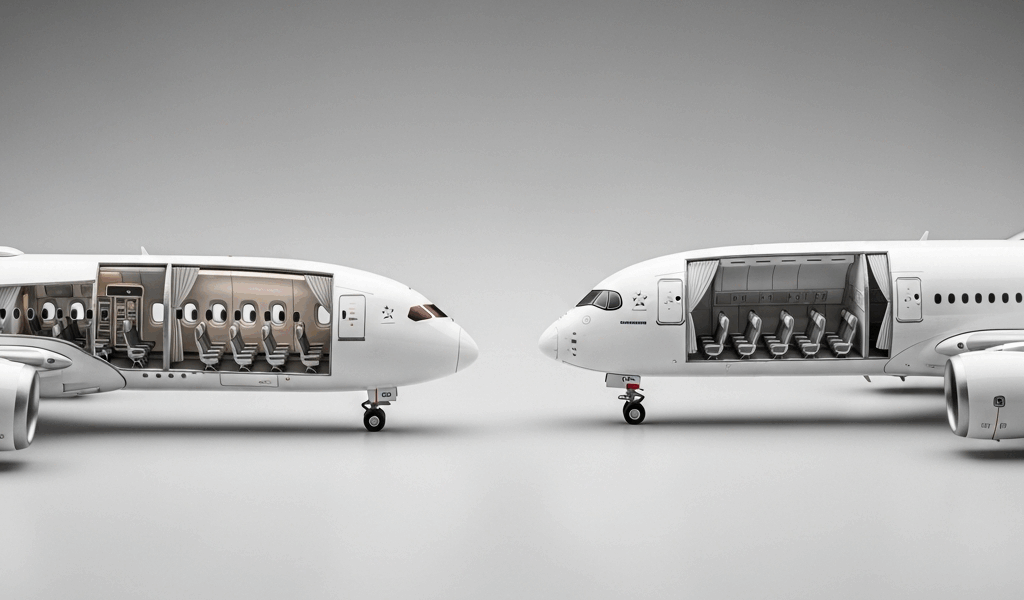
Boeing 787 vs Airbus A350 — Which Is Better for Passengers?
The Boeing 787 vs Airbus A350 debate has gotten complicated with all the conflicting opinions flying around frequent flyer forums. And honestly, fair enough — these two jets represent the best long-haul flying available right now. As someone who has flown both aircraft across multiple carriers, I learned everything there is to know about what actually separates them at 35,000 feet. Qatar Airways’ A350-1000 from Doha to London. United’s 787-9 from Newark to Zurich. The differences are real, measurable, and they matter — depending on what you actually care about. This isn’t a spec sheet. It’s a practical guide for passengers who want to land feeling human.
Both aircraft entered service within a few years of each other — the 787 in 2011, the A350 in 2015 — and both were designed from the start with passenger comfort as a genuine engineering goal. Carbon fiber composite fuselages on both. Higher cabin pressure on both. Better humidity on both. But the details diverge in ways that start to matter somewhere around hour seven.
Cabin Width and Seat Comfort
Probably should have opened with this section, honestly, because cabin width is the single most tangible difference you’ll feel in economy class.
The Airbus A350 has a fuselage interior width of approximately 220 inches at the cabin floor. The Boeing 787 sits at around 215 inches. That’s roughly five inches — doesn’t sound like much written down. In practice, spread across a nine-abreast economy configuration in a 3-3-3 layout, those five inches translate into meaningful seat width differences that your shoulders will notice before your brain does.
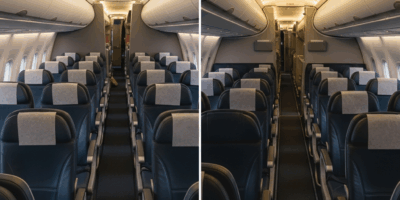
Economy seats on the A350 typically come in at 18 inches wide in a standard nine-abreast setup. The 787 in the same configuration delivers around 17 inches. One inch per seat. Sounds small. But after eight hours sitting in one place, that inch is the difference between your shoulder touching your neighbor’s and having a small — but real — buffer of personal space.
Some carriers configure the 787 in a nine-abreast layout that squeezes seats to as narrow as 17 inches, technically within acceptable IATA standards but genuinely tight on a transatlantic crossing. The A350’s extra fuselage width gives airlines more structural slack. Even budget-configured A350s — French Bee on Paris to Los Angeles, for instance, running a dense leisure configuration — tend to hold that 18-inch standard.
What This Means in Business and Premium Economy
In business class, the width difference matters less. Most lie-flat beds on both aircraft run between 22 and 24 inches wide. Qatar Airways’ Qsuite on the A350 is widely considered the best business class flying right now — but that’s about product design, not fuselage diameter. British Airways flies the 787 with a Club Suite that’s genuinely competitive. That’s what makes aircraft type endearing to us frequent flyers in business class: it almost doesn’t matter. The carrier makes the call up front.
Premium economy is where the A350 advantage reasserts itself. Singapore Airlines’ Premium Economy on the A350-900 offers 19.5-inch seat widths — almost three inches wider than some 787 premium economy seats from other carriers. The extra room starts approaching what some business class products offered a decade ago. Don’t make my mistake of booking premium economy on a 787 without checking the specific configuration first.
Cabin Pressure and How You Feel After Landing
Both the 787 and A350 changed what cabin pressure could be. Older aircraft — the Boeing 767, the Airbus A330 — maintain cabin pressure equivalent to roughly 8,000 feet altitude. That’s what your body is managing while you try to sleep across the Atlantic. It contributes to fatigue, headaches, that classic post-flight hollowed-out feeling.
The 787 dropped that equivalent altitude to 6,000 feet. The A350 sits around 6,000 feet as well, with certain conditions bringing it slightly lower depending on Airbus’s marketing on any given day. For practical purposes, both aircraft represent a genuine improvement over older widebodies. Most passengers flying either one for the first time report feeling less destroyed on arrival.
Where the 787 has a documented edge is humidity. Boeing’s composite fuselage doesn’t corrode the way aluminum does — which allowed engineers to push cabin humidity to around 15 to 16 percent. Older jets ran at 4 to 8 percent. Desert dry. That’s why your skin feels rough after a long flight and your nose gets congested somewhere over Canada. The A350 also benefits from composite construction and runs humidity higher than older jets, but Boeing’s system pushes it slightly more aggressively.
Frustrated by feeling completely hollowed out after a 14-hour flight on an older 777, I started actually tracking how I felt after landing on newer equipment. The 787 from Newark to Zurich — about eight and a half hours, middle seat, barely slept — left me meaningfully more functional than expected. Less destroyed than after comparable flights on older jets with the same amount of sleep, which is to say almost none. The humidity difference is real. Drink water anyway.
The Composite Fuselage Advantage Both Share
Worth being direct about this. Both aircraft use carbon fiber reinforced plastic composite for the majority of their fuselage construction. Both maintain higher humidity without risking corrosion. Both represent a step change from aluminum-framed predecessors. The 787’s humidity advantage over the A350 is marginal — the difference between feeling good and feeling slightly better, not the difference between miserable and comfortable.
Noise Levels at Cruise
Flying is loud. Just true. But it’s louder on some planes than others, and on a 12-hour flight, the difference between a quieter and noisier cabin is the difference between arriving with some actual rest and arriving having spent half a day vibrating inside a metal tube.
The A350 is generally rated as marginally quieter at cruise than the 787. Airbus designed the A350 with extensive acoustic attention — the cabin insulation is serious, and the Rolls-Royce Trent XWB engines are among the quietest high-bypass turbofans currently in service. Independent cabin noise measurements put the A350 at roughly 60 to 63 decibels in economy at cruise. The 787, running GEnx or Rolls-Royce Trent 1000 engines, comes in slightly higher — around 62 to 65 decibels in comparable positions.
Both are significantly quieter than the Boeing 767 or older Airbus A330, which can run 65 to 70 decibels in economy. Both beat the Boeing 777, which has a reputation for being a relatively loud cabin despite its range and size. Coming from a 777 and boarding either of these aircraft for the first time, the improvement is obvious. Between the 787 and A350 specifically, the A350 wins on noise — but you need to actually be paying attention to notice it.
The 787’s GEnx engines have that distinctive chevron nozzle pattern — the serrated, saw-tooth edges on the nacelles you’ve probably noticed without knowing what they were. Boeing designed those specifically to reduce noise. They work. But the A350’s overall acoustic package edges it out in most real-world assessments. That’s what makes the A350 endearing to us noise-sensitive passengers trying to sleep through a transpacific red-eye.
Windows, Lighting, and the Visual Experience
This is where the 787 wins. Completely, and without much contest.
Boeing put electrochromic dimmable windows on the 787. No shades. Instead, a button on the window panel cycles through five tint levels — fully clear to a deep blue-gray that blocks most direct sunlight while still letting you see outside. The windows themselves are significantly larger than on most commercial aircraft, approximately 19 inches tall and 11 inches wide. Boeing claims that’s 65 percent larger than windows on comparable jets. Apparently that number is accurate. They’re big.
Sitting in a 787 window seat is a different psychological experience. The windows are large enough to see the actual horizon. On a clear day over Greenland, the view is something. On a night flight — cabin lights dimmed, window cycled to full clear — the sky is visible in a way that feels almost cinematic. Sounds frivolous. Isn’t.
The A350 has standard manual window shades and windows that, while reasonably sized, don’t approach the 787’s dimensions or the electrochromic technology. The A350 does have an excellent cabin lighting system — programmable LED lighting that transitions through warm and cool tones to simulate daylight cycles and assist with circadian adjustment on long-haul routes. Cathay Pacific uses this deliberately on their A350 services. It works well. But what is electrochromic window technology? In essence, it’s a chemically treated glass panel that changes opacity with an electrical current. But it’s much more than that — it’s the reason a window seat on a 787 feels like a different category of flight.
Tricked into thinking lighting wouldn’t matter on a red-eye, I used to close the shade immediately on older jets. On the 787, I left the window open for most of a transatlantic crossing and genuinely felt less claustrophobic throughout. Small thing. Also not small at all.
LED Ambiance and Mood Lighting
The 787 has mood lighting throughout the cabin. Boeing worked with interior teams to offer programmable LED systems, and carriers like ANA and Japan Airlines — both major 787 operators — use it extensively. JAL’s 787-9 Sky Suite cabin lighting transitions through at least four distinct color states during a typical transpacific flight. Thoughtful. It works. The A350’s Airbus Airspace cabin has comparable technology, so this is more of a draw than a decisive advantage for either aircraft. Both beat the fluorescent overhead lighting on whatever 767 you flew in 2009.
The Verdict — Which to Choose When Booking
Here’s the honest answer. Choose the A350 if seat width and physical comfort in economy are your priorities. Choose the 787 if you care about natural light, large windows, or the humidity advantage on very long flights.
For most economy passengers on routes longer than eight hours, the A350’s wider seat configuration — that extra inch — is the most tangible benefit you’ll notice over the course of a flight. Bodies are physical things. Space matters. The A350’s fuselage gives airlines more structural room to work with, and even on aggressively configured carriers, that advantage tends to preserve seat width better than comparable 787 setups.
For passengers who sleep well regardless of seat width, or who are traveling in business or first class, the 787’s window experience is genuinely special. No other commercial aircraft flying regular routes has windows that compare in size or technology. If you’ve never looked out of a 787 window at night over the ocean on a clear night, you’re missing something that sounds frivolous and isn’t.
- Best for economy comfort overall — Airbus A350, due to wider cabin and 18-inch seat standard
- Best window experience — Boeing 787, by a significant margin
- Best post-flight freshness — Boeing 787 slightly, due to humidity management
- Quietest cabin — Airbus A350, marginally
- Best business class product — Carrier dependent, not aircraft dependent
One thing worth pushing back on — the idea that you should obsessively optimize for aircraft type when booking. Airlines matter more than aircraft in most cases. Qatar Airways’ A350 in economy beats some carriers’ 787 business class. Singapore Airlines’ 787-10 is configured with more passenger care than plenty of A350 operators out there. Know the carrier, know the configuration — SeatGuru and AeroLopa will show you the specific seat layout before you commit to anything.
But when all else is equal — same airline, same route, same fare — the A350 edges out the 787 on pure economy-class comfort, and the 787 takes it on the sensory experience of actually being on an airplane and looking out at the planet below you. Both aircraft are remarkable. Either one beats flying a 767. That part, at least, isn’t a close call.


Stay in the loop
Get the latest flighttechtrends updates delivered to your inbox.